One platform is manageable, but five create friction. Managing one social media platform is relatively manageable. A team creates content, uploads media, publishes posts, and reviews analytics within the same environment. The workflow stays organized because everything exists in one place.
The situation changes once multiple platforms are involved.
Now the same campaign must be adjusted for Instagram, LinkedIn, TikTok, Facebook, and X. Captions need edits. Video dimensions change. Hashtags vary by platform. Scheduling workflows becomes fragmented. One post quickly turns into multiple separate tasks.
Most teams are not struggling because social media is difficult. They are struggling because managing multiple platforms results in redundant work at every stage.
One Campaign Can Create Hours of Extra Work
Take a common scenario, a marketing team prepares a campaign containing 12 posts for the week. The content itself is already complete. At this stage, most people assume the difficult part is finished.
It is not.
Now the team begins platform distribution. Instagram captions need hashtags and spacing adjustments. LinkedIn requires a more professional format. X requires shorter text. TikTok videos may need different dimensions or captions.
The same media files are uploaded repeatedly. Posts are previewed separately across platforms. Scheduling happens individually. Small formatting issues appear and require manual fixes.
If publishing one post takes 15 to 20 minutes per platform, distributing across five platforms can consume 75 to 100 minutes for a single piece of content. Now multiply that by 12 weekly posts. That results in 15 to 20 hours spent only on distribution.
That is not a content strategy. It is operational duplication.
Every Platform Creates Another Workflow
The issue is not just workload, but fragmentation.
Each platform operates differently. Instagram prioritizes visuals and hashtags. LinkedIn favors professional formatting. TikTok focuses heavily on short-form video behavior. X rewards shorter copy and faster posting frequency. Because of this, teams cannot rely on one universal workflow.
Every platform introduces another process that must be managed separately. This creates a fragmented environment where teams are constantly adjusting, switching, editing, and rechecking content across systems. Instead of operating through one organized workflow, teams maintain multiple disconnected ones simultaneously.
More Tools Usually Increase Complexity
Most teams attempt to solve this problem by adding tools. One tool for scheduling, another for analytics, another for approvals, another for reporting, and another for content storage.
Initially, this appears organized. In practice, it creates another layer of complexity.
Now the team is not only switching between social media platforms. They are also switching between software built to manage those platforms. A typical marketing team can easily operate across 5 to 7 different systems just to maintain social media operations.
Each tool handles one part of the process while creating additional coordination work elsewhere. The result is more tabs, more logins, more duplicated actions, and more opportunities for mistakes.
The Time Loss Becomes Very Expensive
The biggest issue is how quickly small delays accumulate:
· Five minutes adjusting formatting.
· Ten minutes correcting captions.
· Another few minutes checking previews.
· Another few minutes moving between dashboards.
Individually, these tasks appear minor. Combined, they become expensive.
Let’s look at the numbers.
A marketing employee earning $60,000 annually costs approximately $30 per hour. If that employee spends 15 hours per week managing multi-platform workflows, that amounts to $450 per week.
Over one year, that amounts to more than $23,000 spent on platform coordination. For a team of three employees, the annual cost exceeds $69,000.
That is a substantial amount of money directed toward workflow management rather than growth.
Context Switching Reduces Productivity
Another issue most teams underestimate is context switching.
Every time someone moves between platforms or tools, the workflow changes. The layout changes. The process changes. Research shows frequent task switching can reduce productivity by up to 40 percent. This means a large portion of the workday is spent on transition time rather than on productive execution. The work itself is often manageable.
The constant switching between systems is what slows teams down.
More Platforms Create More Mistakes
Complex workflows naturally increase errors.
Captions may be updated on one platform but remain outdated elsewhere. Media uploads may fail. Posts may unintentionally go live at different times. Formatting inconsistencies become common.
For example, a campaign intended to launch simultaneously across all platforms may appear on Instagram at 9 AM while LinkedIn posts several hours later because one scheduling step was missed.
These problems seem small individually, but repeated mistakes create delays, additional revisions, and wasted effort.
Manual coordination across multiple systems significantly increases error frequency.
Most Teams Accept This As Normal
This is where the problem becomes deeply embedded.
Teams assume this level of complexity is unavoidable because social media management has operated this way for years. They accept repeated workflows, endless switching, and fragmented systems as part of the process. It does not need to operate this way. The issue is not the number of platforms.
The issue is the lack of a centralized workflow.
Centralization Changes the Workflow Completely
The solution is not reducing platforms. Brands still need visibility wherever their audience spends time.
The solution is reducing fragmentation.
When planning, scheduling, approvals, publishing, and analytics are integrated into a single connected system, the workflow becomes significantly more efficient. Teams no longer rebuild the same process for every platform. They operate through a single, organized structure that supports all platforms.
This reduces duplicated effort and eliminates unnecessary switching.
FeedReach Helps Solve The ISSUE
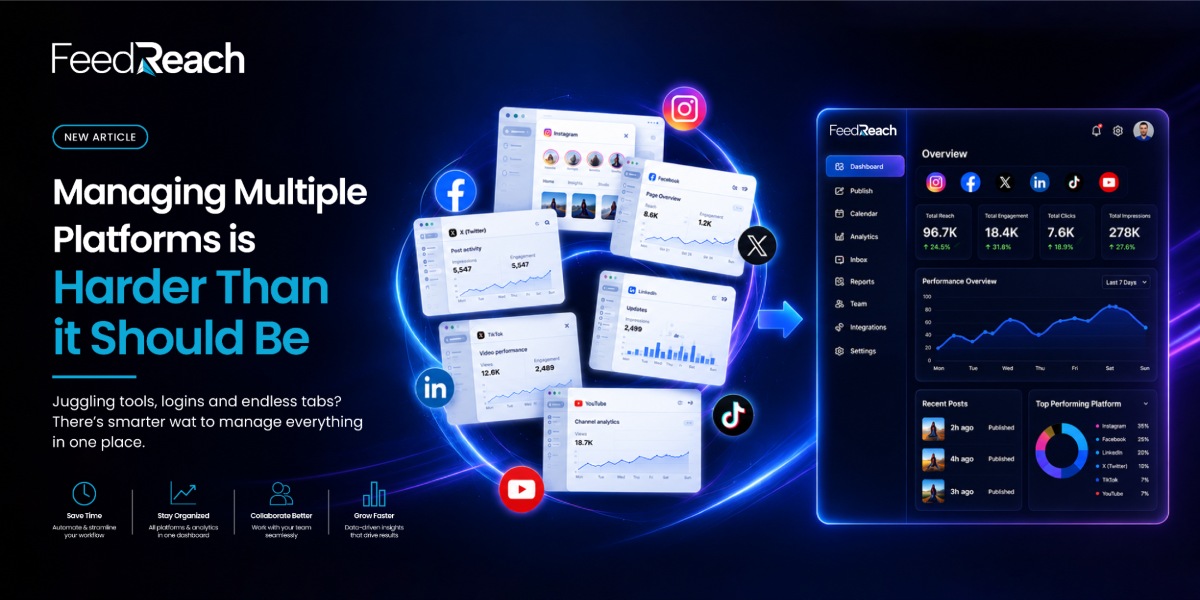
FeedReach is designed specifically to solve this issue by functioning as a centralized dashboard for social media management.
1. Instead of switching between multiple platforms and software tools, teams can manage everything from one location.
2. Content is created once, adjusted where necessary, and distributed across platforms without rebuilding the process repeatedly.
3. Scheduling, approvals, publishing, and analytics happen within one connected workflow.
4. This reduces manual coordination and saves substantial time each week.
5. More importantly, teams spend less time managing systems and more time improving campaigns.
What Changes After Centralization
The improvement becomes visible quickly; a workflow previously consuming 15 to 20 hours weekly can be reduced significantly:
1. Publishing becomes faster as campaign execution improves.
2. Errors decrease because fewer disconnected systems are involved.
3. Teams no longer spend most of their time coordinating platforms.
4. Instead, they focus on improving content, analyzing performance, and increasing output.
5. The complexity of social media does not disappear, but it becomes manageable through organization.
Final Thought
Most teams are not struggling because they lack talent or ideas. They are struggling because fragmented workflows create unnecessary duplication. The problem is not the platforms themselves. It is the disconnected systems used to manage them. When workflows become centralized, execution improves, publishing speeds up, and teams regain valuable time. That is where FeedReach gives teams one place to manage everything without the inefficiencies that slow growth.
Disclaimer: Any claims regarding time savings, efficiency improvements, or reduced errors are illustrative examples and results may vary depending on team size, workflow, platform usage, and other factors.