
He caps every edition at twelve prints. He photographs one subject. And somehow, that discipline has carried his work into collections across more than thirty countries.
In most creative industries, breadth is the goal. More subjects, more styles, more platforms. The conventional path to visibility runs through expansion. Raphael Macek chose the opposite. Twenty-five years ago, the Brazilian fine art photographer committed to a single subject, a single production standard, and a single rule that would come to define both his market position and his artistic identity: no more than twelve prints of any image, in any given size, ever.
That decision, which looks, in retrospect, like either extraordinary discipline or extraordinary confidence, has become the structural foundation of one of the most quietly successful fine art photography careers in the world today. Macek’s limited editions now hang in private homes across more than thirty countries. His work has been shown at Paris Photo and Art Basel Miami. His monograph, published by the prestigious German house teNeues and available in five languages, introduced him to a global collector audience that has only grown since.
The rise, as his collectors will tell you, was not sudden. It was the result of a philosophy applied with uncommon consistency across a quarter of a century.
Why Twelve
The decision to cap editions at twelve per size is not arbitrary. In the fine art photography market, edition size is the primary signal of value, the mechanism by which scarcity is established, maintained, and communicated to future buyers. Macek understood this early, and built his entire production model around it.
Every print that leaves his studio, InnFRAME, his own large-format archival operation in South Florida, is numbered, signed, and accompanied by a certificate of authenticity that the studio retains in perpetuity. The papers are Hahnemühle 100% cotton rag, acid-free, with an archival life exceeding two hundred years, as certified by Wilhelm Imaging Research. When collectors elect for it, mounting uses the Diasec face-mount process, the same system used by the most demanding fine art photographers in the world. The cameras are Phase One IQ4 systems at 150 megapixels, capable of holding full detail at print sizes that most photographic systems cannot approach.
The result is an object that is, at every level, built to last. Not just aesthetically, but physically, legally, and economically. The edition is capped. The print is archival. The provenance is documented. And the pricing, from $6,500 at the entry point to more than $23,000 at the top of the size matrix, reflects a market that understands what it is buying.
“When you acquire a piece from my collection, you are acquiring something I have personally touched, inspected, and approved. It is a piece of my life’s work.”
— Raphael Macek
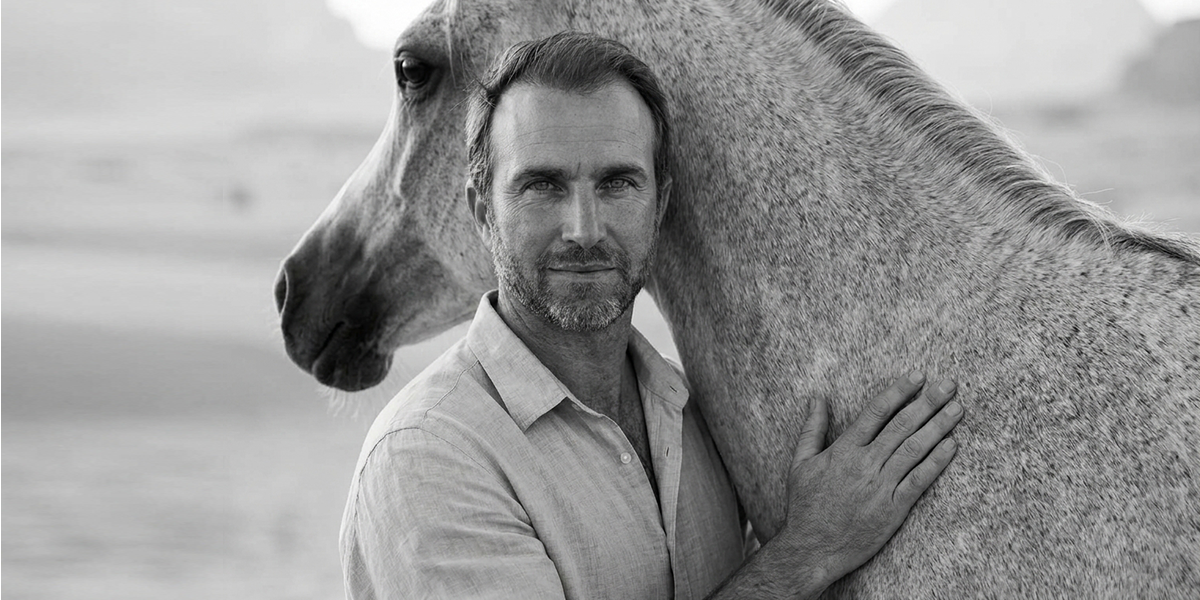
The Equestrian Vision
What the editions carry, of course, is the work. And the work begins somewhere that no edition size or archival rating can manufacture, in the relationship between Macek and his subject.
He was born in São Paulo to a family in which the horse was not a decorative presence but a vocation. His father was a veterinarian who bred racehorses for the São Paulo Jockey Club. His mother moved the family to the farm when Raphael was barely a year old. He would live there until age eight, among horses, as a constant presence. Not a rider, not a spectator, but what his mother later described as one of them. That formation, bodily and instinctive, is the bedrock of an equestrian vision that no amount of technical sophistication could replicate without it.
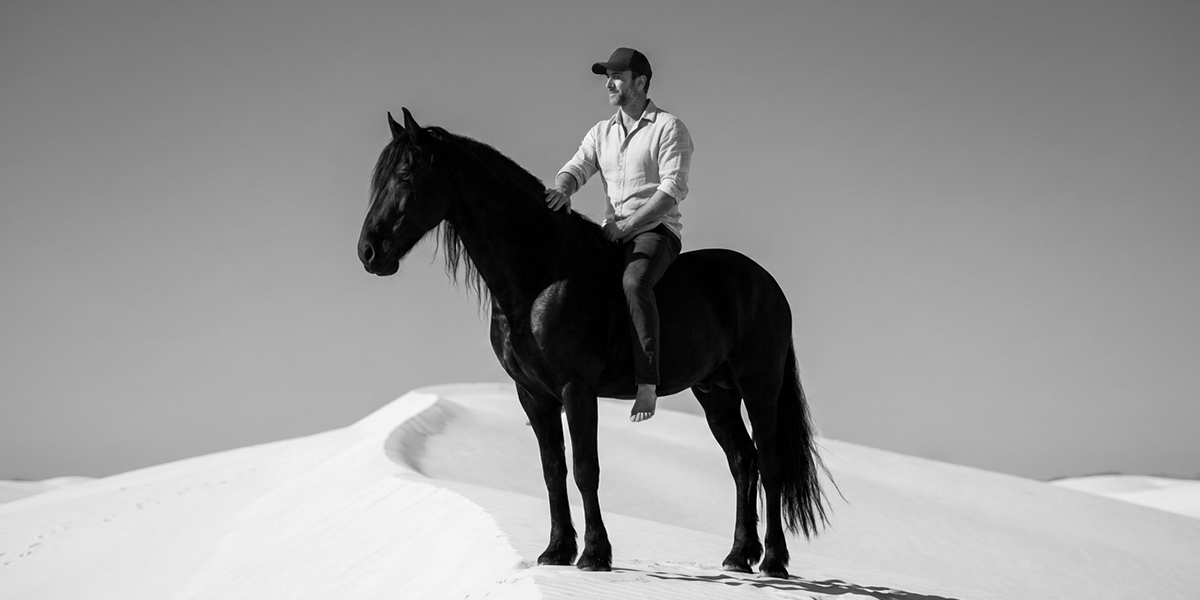
The vision itself has evolved over twenty-five years, from natural light work in Brazil, through a decade of studio mastery, to his most ambitious project yet, the collection Over the Dunes, shot in the Emirates at dawn and dusk, with Arabian horses moving freely across the desert landscape that created their breed. The collection is entirely monochrome. Macek’s reasoning: color makes the desert beautiful. Black and white make it honest. Strip away the gold of the sand and the cobalt of the sky, and what remains is form. The curve of a spine echoes the curve of a dune, the dialogue between body and void that is the desert’s only language.
The Reach
Twelve prints per size. One subject. Twenty-five years. The mathematics of that combination, applied consistently across a global gallery network spanning Greenwich, Connecticut; Dubai; London; Miami; Berlin; Madrid; and Brussels, has produced a collector base that spans more than thirty countries and functions, by all accounts, less like a customer list and more like an international community.
The work appears in private residences from Palm Beach to Riyadh, from São Paulo to Singapore. It moves on the secondary market without losing its pricing structure, a rarity in the fine art photography world, where discounting is endemic, and edition discipline is often more aspirational than real. And it has accumulated, year after year, the kind of institutional visibility that confirms rather than creates market position. More than twenty-five solo exhibitions internationally, more than thirty art fairs inclusions, and a presence at the two fairs, Paris Photo and Art Basel Miami, that define the photographic medium’s highest tier.
Macek’s role as Official Creative Ambassador for American Wild Horse Conservation has added a dimension that the numbers alone do not capture. A public commitment to the wild herds of the American West that roots the commercial career in something older and less transactional, and that resonates with collectors for whom the horse is not merely an aesthetic subject but a cultural and ecological one.
The Philosophy Behind the Rise
The Macek model rests on a position that has become increasingly relevant in the current cultural moment. His guiding phrase, Real Will Always Be Rarer, is a direct response to the accelerating production of synthetic imagery. The argument is that when images can be generated at near-zero cost by machines that have never stood in a desert, never waited hours for a piece of light, never spent twenty-five years preparing to lift a camera, the photograph that was actually made will not lose value. It will gain it.
That argument is not merely rhetorical. It is built into every layer of the practice. The natural light, the 150-megapixel sensor, the cotton rag paper, the signed edition, the proprietary studio, the decades of relationship with a subject that cannot be prompted into existence. The limited edition, in this reading, is not a marketing device. It is a moral position, a refusal to treat the image as infinitely reproducible, a commitment to the idea that scarcity, properly maintained, is the most honest thing a fine art photographer can offer.
Twenty-five years in, with collections on every continent, the rise of Raphael Macek’s equestrian vision shows no sign of reaching its ceiling. The editions remain limited. The reach, by every measure, does not.
Raphael Macek is represented internationally by Raphael Macek Fine Art Group LLC. Works are held in private collections across more than thirty countries. Acquisition inquiries: raphaelmacek.com · gallery@raphaelmacek.com