
In our modern, hyper-scientific era, it is easy to believe that the ultimate mysteries of human existence have been reduced to mere chemistry. We are frequently told that love is just oxytocin, that sadness is a lack of serotonin, and that consciousness itself is nothing more than the hum of electrical signals bouncing across the intricate meat of the brain.
Yet, despite our incredibly advanced maps of the human nervous system, science has fundamentally failed to cross the ultimate threshold. It has failed to answer what philosophers call the “Hard Problem”: How does unconscious matter produce a private, rich, subjective inner world? How does the universe wake up and say, “I am”?
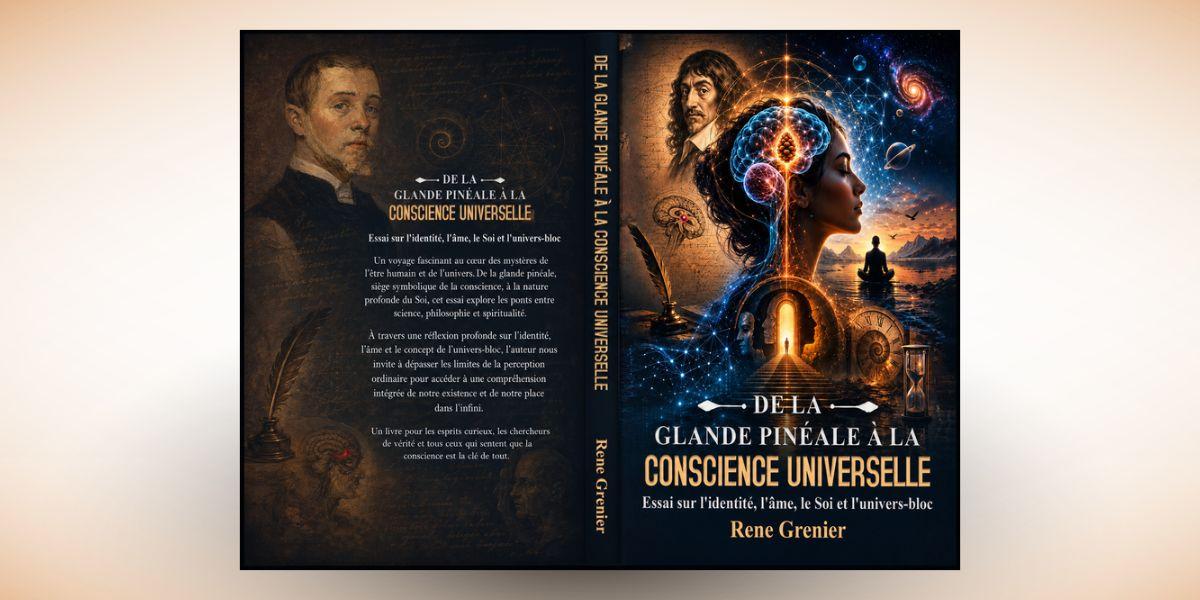
In his philosophical work De la glande pinéale à la Conscience universelle, author René Grenier steps into the gap between hard science and deep metaphysics. He takes readers on an intellectual expedition that begins with the historical roots of the mind-body problem and expands outward into a new cosmology of the human soul.
The journey begins with René Descartes, who famously hypothesized that the soul interacted with the mechanical body through the pineal gland. While modern science has dismissed this specific biological function, Grenier argues that Descartes’ fundamental intuition was pointing toward a mystery that is more relevant today than ever. If we are not simply our bodies, then what exactly is the nature of the “I”?
Grenier examines our everyday assumptions about identity. He introduces a psychological and philosophical framework that separates the human experience into distinct layers. First, there is the Persona, the outward-facing character we construct to navigate society. Beneath that lies the Ego (the Moi), the conscious narrator of our lives, fiercely attached to its autobiography and its memories.
But Grenier asks us to consider a radical proposition: What if memory is not the anchor of identity? We all know that memories are fragile. They alter, they fade, and they can be entirely lost. If your identity is solely based on your memories, then you are diminishing every single day. Grenier suggests that beneath the fleeting Ego lies the true Self (the Soi), a deeper principle of continuity that integrates our experiences, transforming them into wisdom and essence, even when the conscious memory of the event has vanished.
That idea leads the book into its most expansive territory. If the true Self is not dependent on the fragile biological hard drive of memory, could it be that the soul is not a closed, isolated bubble? Grenier explores the possibility that individual consciousness might not be an anomaly in a dead cosmos, but rather a localized, focused individualization of a Universal Consciousness.
De la glande pinéale à la Conscience universelle brings together psychology, historical philosophy, and metaphysical speculation. It does not dictate absolute dogmas. Instead, it offers a framework for thinking about the soul in the 21st century. The book is written for the seeker, the skeptic, and the deep thinker who looks up at the night sky and feels a connection to the infinite.