By: Mason Everett
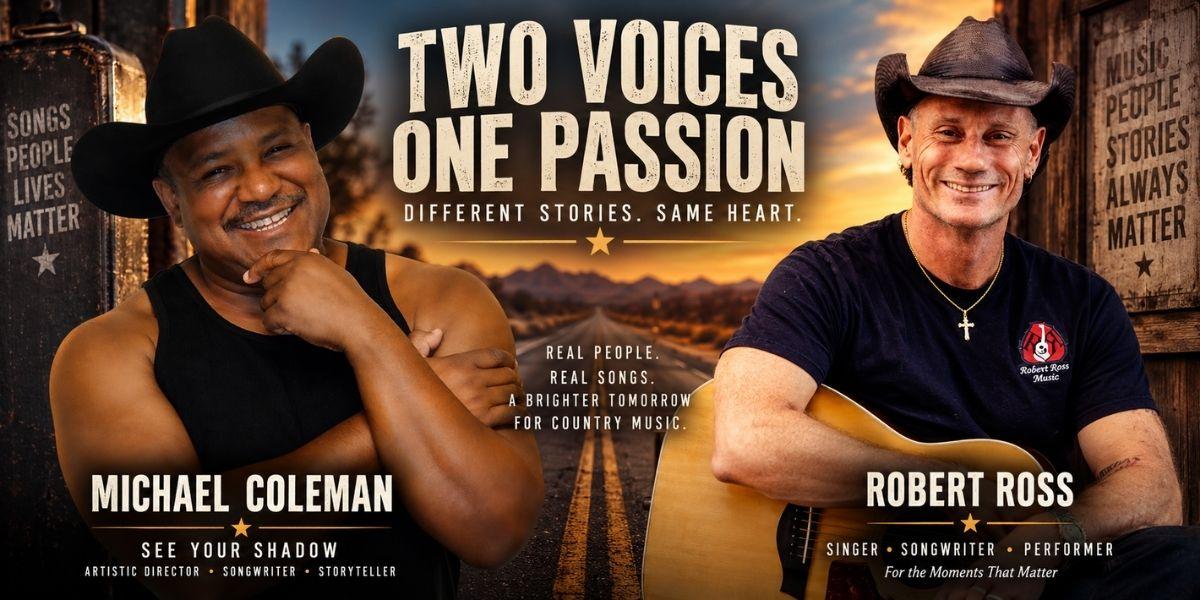
Country music has always been large enough to contain contradictions. It can be intimate and theatrical, traditional and experimental, brokenhearted one minute and hopelessly romantic the next. Two independent acts currently illustrating that range are See Your Shadow and Robert Ross, artists approaching the genre from markedly different directions while arriving at essentially the same destination: the human story.
For See Your Shadow, that story begins with Michael Coleman, the Phoenix-based songwriter, producer and Artistic Director behind one of independent country’s more unconventional creative operations. See Your Shadow isn’t a band in the usual sense. Coleman instead works with what he calls his “Network of Stars,” bringing different singers and musicians together according to the needs of each composition.
The philosophy effectively reverses the modern music-business equation. Rather than building songs around a marketable personality, Coleman builds the personnel around the song.
It’s an approach that has produced an impressive body of work. Coleman’s official biography credits him with nine independent-radio chart-topping singles, including five international iTunes No. 1s. His catalog includes songs such as “Missing West Virginia,” “I Will Tell Jesus You Said Hello,” “Showdown,” “Today I Do Become I Don’t,” “Crazy Things Like That” and “Whatever on the Rocks.”
The latest chapter is “Another Saturday,” and it might be one of the clearest demonstrations yet of what makes Coleman an intriguing songwriter.
The song doesn’t take listeners into the excitement of Saturday night. It arrives afterward.
Its central character wakes beside a stranger, sends him away and begins another morning alone. She’s no longer somebody’s wife, but she hasn’t quite figured out who she is without that identity. Coleman has explained that he wrote the song years ago, rediscovered it among his handwritten work and restructured the piece before recording it. He believes its loneliness gives the story a universality that allows almost anyone to recognize something of themselves in its protagonist.
The striking thing is Coleman’s refusal to punish her.
There is no sermon lurking behind the narrative and no miraculous romantic rescue before the final chorus. “Another Saturday” is interested in the messy territory between heartbreak and healing, the period when people know something has changed but haven’t yet learned how to live differently.
If See Your Shadow examines love’s aftermath, Robert Ross comes charging toward it from the opposite direction.
The Canadian-born country singer-songwriter’s “For You Girl” is about surrendering to romantic possibility with almost reckless enthusiasm. Released February 27, 2026, the track was co-written by Ross and producer Gil Grand, and Ross has described his intention as capturing the experience of falling hard and fast for someone capable of unexpectedly transforming your world.
There isn’t much emotional camouflage here.
Ross sings like a man who has already accepted the consequences of falling in love. The performance works because he doesn’t approach romantic devotion with a wink. In a cultural moment when sincerity can sometimes seem more dangerous than cynicism, Ross simply commits.
The record also surrounds him with formidable Nashville musicians. Troy Lancaster contributes lead guitar, Joe Spivey acoustic guitar, Dan Dugmore pedal steel and Mike Rojas piano, with the arrangement giving “For You Girl” a polished contemporary surface while retaining recognizable country textures.
Ross brings considerable life experience to that performance. He’s an artist whose path has crossed countries, stages and musical communities, and whose recording “Drink Em Down” found a broader audience through its placement in Tulsa King. With “For You Girl,” though, there is no need for an elaborate narrative concept. The emotional proposition is refreshingly direct: somebody has changed his world, and he’s going after her.
Put Ross beside See Your Shadow and an interesting conversation about contemporary independent country begins to emerge.
Coleman writes about the woman waking up after the relationship has disappeared.
Ross sings from the moment when the relationship seems capable of becoming everything.
One is uncertainty.
The other is possibility.
One looks into the mirror after the party. The other races headlong toward love.
Yet neither artist treats emotion as something requiring irony.
That may be their most meaningful common ground.
Independent country music doesn’t necessarily need to compete with Nashville by trying to make bigger records. Its advantage can be the freedom to make more specific ones, to tell stories about adults whose lives don’t conform neatly to radio archetypes.
See Your Shadow does that through an unusual collective model in which Coleman’s songwriting remains the connective tissue regardless of who steps to the microphone. Robert Ross does it through a recognizable, lived-in vocal presence that gives straightforward sentiments the credibility of experience.
Their recent singles consequently feel almost like opposite pages from the same book.
“For You Girl” asks what happens when another person suddenly makes the future seem limitless.
“Another Saturday” asks what happens when the future you once imagined has vanished.
Between those two emotional poles lies a significant portion of country music’s reason for existing.
People fall in love.
People lose it.
People promise forever.
People wake up wondering what happened to forever.
Robert Ross and See Your Shadow simply enter the story at different moments.
And both understand the principle that has kept country music alive through every change in fashion, technology and production:
When the story feels human enough, somebody will recognize their own life inside it.