
By: Jenna Wilson
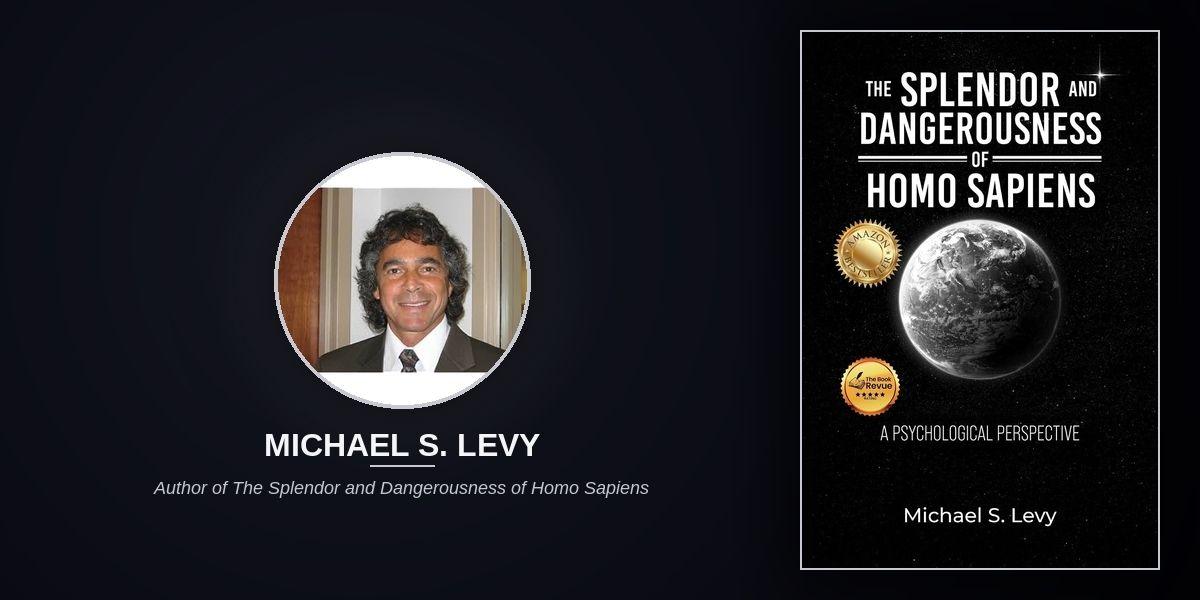
There is a particular kind of authority that accumulates through decades of clinical work with human beings at their most vulnerable and their most destructive, and Michael S. Levy, PhD, brings that authority to The Splendor and Dangerousness of Homo Sapiens with the quiet confidence of someone who has been studying the same essential problem at different scales for his entire professional life. He has served as the clinical director of multiple mental health and substance use treatment programs. He has spent years lecturing in the Division of Addictions at Harvard Medical School. He has published extensively on individual human psychology and its most painful expressions. And now, in this book, he has stepped back from the individual and asked the question that his career has been building toward without quite arriving at until now: what does all of that clinical experience tell us about the species as a whole, about the specific traits that make human beings simultaneously the most remarkable and the most dangerous form of life this planet has ever produced?
The answer he arrives at is organized around three defining human attributes that Levy has spent his career watching operate at the individual level and that he now argues operate at the civilizational level with the same combination of extraordinary power and extraordinary potential for destruction. Refined consciousness, advanced cognitive ability, and the unmatched capacity for communication: these are the traits that produced medicine and space exploration and the accumulated cultural and intellectual heritage of human civilization, and these are the same traits that produce conflict and environmental destruction and the epidemic of disinformation that is steadily eroding the institutional trust on which every functioning society depends.
Reading this book produces the specific quality of uncomfortable recognition that the best psychological writing always generates at its most effective: the feeling of seeing patterns you have been living inside clearly enough to understand them for the first time. Levy writes with the clinical precision of someone who has analyzed human behavior under controlled conditions for decades, and with the genuine alarm of someone who has extended that analysis to the civilizational scale and found the picture considerably more concerning than it might appear when the problems are addressed individually. He is not alarmist. He is honest, which is occasionally more unsettling than alarm.
The book occupies shelf space alongside Yuval Noah Harari’s Sapiens and Robert Sapolsky’s Behave, but it distinguishes itself through Levy’s clinical lens and his focus on consciousness as the root cause of what he describes. This is not a book about evolution or history in the conventional sense. It is a book about what happens inside human minds when the remarkable capabilities of consciousness interact with unchecked self-interest, and what the aggregate of those individual psychological dynamics produces at the level of institutions, societies, and the planet itself.
Levy does not leave the reader without direction. The practical suggestions he offers for tempering human nature and shifting our collective trajectory reflect the same orientation toward realistic, achievable change that characterizes the best clinical work, grounded in what human beings are actually capable of rather than what a more optimistic view of human nature would wish them to be. That combination of honest diagnosis and practical prescription is what makes this book genuinely valuable, not simply sobering.
If you have been watching the current state of the world and wanting a framework that actually explains what you are seeing at the level of the psychology that produces it, The Splendor and Dangerousness of Homo Sapiens by Michael S. Levy, PhD, is the book that provides it. Grab your copy on Amazon today and discover what decades of clinical experience at the individual level reveals about the human species as a whole.