By: Fabiana Simmons
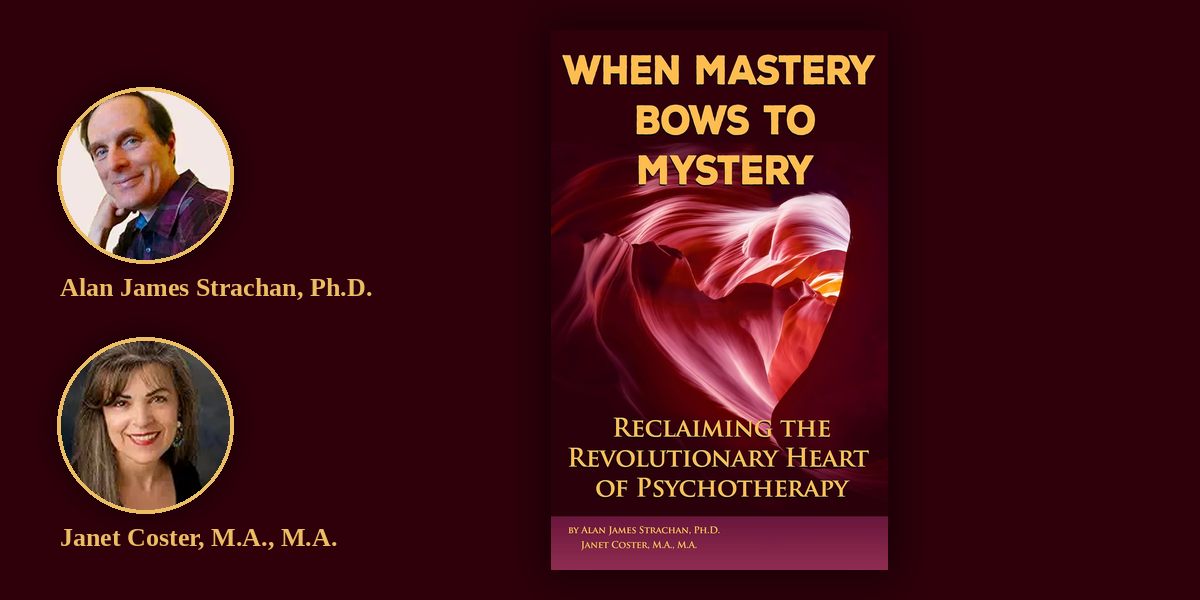
There is a particular kind of professional courage required to look at the field you have spent four decades inside and say clearly and without apology that something essential has gone missing, that the drift toward technique and diagnosis and symptom management has cost psychotherapy something it cannot afford to lose, and that recovering it requires not a new method but a fundamental reconsideration of what therapy is actually for. Alan James Strachan and Janet Coster write from exactly that position, and When Mastery Bows to Mystery is where they set the argument out in full.
The title is itself an argument. Mastery, in contemporary clinical practice, has come to mean the command of evidence-based techniques, the application of validated protocols, the management of diagnoses toward measurable outcomes. Mystery is what gets quietly squeezed out when mastery becomes the only value, the irreducible strangeness of one human being truly encountering another, the unpredictable potential of a relationship built on empathy, dignity, and genuine presence rather than clinical expertise alone. Strachan and Coster are not arguing against competence. They are arguing against the reduction of therapy to competence, and the distinction is one that anyone who has sat on either side of a therapeutic relationship will recognize immediately.
The book can produce a particular kind of clarifying discomfort, the kind that arrives when someone articulates something you have felt but never quite managed to name. For therapists who have sensed the growing gap between what their training prepared them to do and what their clients actually need, the book offers both the language for that gap and a serious philosophical framework for beginning to close it. For everyone else, it opens a window into what psychotherapy at its deepest and most human level has always been, and what it must reclaim in order to remain transformative rather than merely technically proficient.
The breadth of intellectual tradition Strachan and Coster draw on, psychology, spirituality, philosophy, and the political dimensions of human suffering, carries the book across territory that professional writing on therapy usually keeps separate. Their insistence that therapy is not just a personal and relational act but also a radically ethical and sociopolitical one is one of the book’s central arguments, connecting the intimate work of the consulting room to the larger forces that shape human consciousness and human society. That connection gives the book a moral seriousness and a cultural relevance that extends well beyond the professional audience it is most directly addressing.
When Mastery Bows to Mystery enters a debate the field of psychotherapy is actively having, it is written with the combined wisdom of more than four decades of clinical experience and a lifelong commitment to the kind of integrated human understanding that refuses to separate the psychological from the spiritual or the personal from the political.
Readers who have sensed that something has gone missing from the way therapy is practiced and discussed today, and who have wanted a clinician’s account of what that loss consists of and what recovering it would require, will find that account in When Mastery Bows to Mystery by Alan James Strachan and Janet Coster.
Disclaimer: This article is intended for general informational and editorial purposes only. It does not provide medical, psychological, psychiatric, therapeutic, spiritual, or mental health advice, and it should not be relied upon as a substitute for guidance from a qualified professional. Any discussion of psychotherapy, clinical practice, diagnosis, treatment methods, spirituality, emotional well-being, or mental health care is provided for general context only. Readers experiencing mental health concerns should consult a licensed mental health professional, physician, or other qualified provider.