
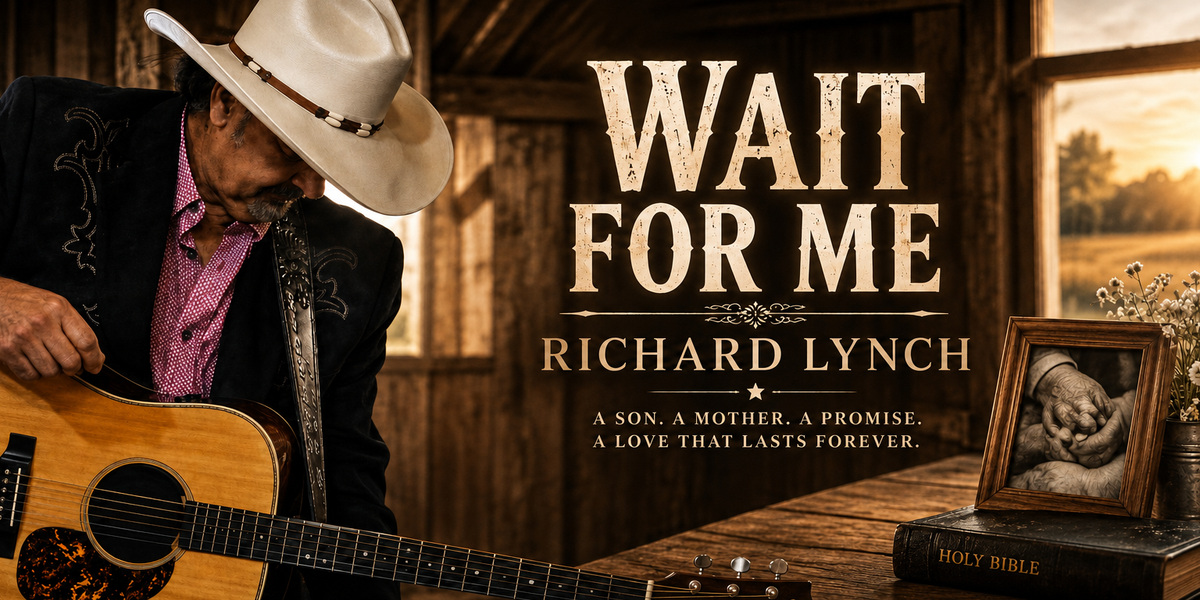
By Rebecca Langford
There is an easy way to hear Richard Lynch’s “Wait For Me”: as a sad country song about a man racing to his dying mother’s bedside. It has all the elements required to activate the machinery of country sentiment, Momma, God, childhood memories, death, devotion. Yet reducing the song to those familiar symbols misses what makes it interesting. Beneath its grief is an argument about obligation: the enormous debt children accumulate simply by being loved.
“Wait For Me,” written by Lynch and John Lee, begins after that debt has become impossible to repay.
Lynch visits his mother and finds her asleep. He stays beside her and holds her hands. He cries, though he insists these aren’t merely tears of grief but of “thankfulness and joy.” Looking at those hands collapses time. The adult son becomes conscious of the little boy who once depended upon them.
This is where the song moves beyond conventional bereavement.
The mother is never described primarily by her personality. Instead, Lynch remembers her through labor. Her hands wiped tears, soothed pain, sewed clothes and, in the song’s largest metaphor, “moved mountains.”
It’s worth considering what that means.
Popular culture has spent generations romanticizing motherhood while simultaneously making much of its work invisible. Mothers nurture because mothers nurture; sacrifice becomes an assumed characteristic rather than something that costs time, energy and pieces of a person’s life. “Wait For Me” initially appears to participate in that mythology, but its fixation on hands makes the sacrifice unusually physical.
These are hands worn out from doing things.
By the third verse, Lynch asks whether they are tired and whether they sometimes ache. He already knows the answer. The things they have done were performed “for someone else’s sake.”
Suddenly the saintly mother of country-music mythology becomes something more tangible: a human being whose body bears evidence of a lifetime spent caring for other people.
The song’s central drama arrives when Lynch learns she is “ready to leave with God.” She has made peace with dying. Her son hasn’t, not completely. He is on his way, and his repeated request is devastatingly primitive:
Hold on. Wait for me.
The phrase contains the selfishness that inevitably accompanies love. If she is ready to die, why should she wait? Because he needs her to. He needs a few more minutes in which the relationship can still exist physically. He needs to get there, to see her, and most importantly, to make certain she understands what she meant to him.
There’s something refreshingly unheroic about that desperation. Lynch isn’t promising to save her. He knows he can’t. His journey toward her bedside is instead an attempt to solve one of adulthood’s cruelest equations: How do you adequately thank somebody for a lifetime?
You don’t.
The most you can do is arrive.
Country music is particularly suited to this kind of story because the genre has always been suspicious of abstraction. Love becomes convincing when somebody does something. A father works. A mother sews. Somebody drives through the night. Somebody stays beside a hospital bed.
“Wait For Me” understands love as action.
Its religious language works similarly. God and heaven aren’t introduced as spectacular revelations. The mother “always believed,” so her approaching death is understood within the vocabulary through which she has apparently understood her life. Lynch doesn’t demand that the listener share that belief to comprehend its importance.
What matters is that she has made peace.
Her son’s struggle is different. He must transform impending loss into gratitude while there is still somebody there to receive it.
That makes the ending crucial.
“Your pain is gone,” Lynch tells her. “Now you can rest.”
Then we learn that she did what the chorus begged her to do.
“You held on / You waited for me.”
It would be easy for a performance built around such material to become manipulative. Country music has never been immune to emotional button-pushing, particularly when motherhood, death and religion occupy the same four minutes. But the strongest idea in “Wait For Me” resists that temptation because it is so specific: those hands.
They keep bringing the song back from heaven to earth.
Hands age. Hands ache. Hands make things, repair things and comfort frightened children. Eventually, the child who once reached upward for them becomes an adult holding them beside a bed.
That reversal is the real subject of “Wait For Me.”
Lynch is singing about the moment when our parents cease being the seemingly permanent infrastructure of childhood and become mortal people whose histories we suddenly understand differently. The discovery can be terrifying because it comes with another realization: there may not be enough time left to say everything.
The final irony is that Lynch’s mother performs one last act of motherhood. After all those years of comforting him, she waits long enough to comfort him again.
He believes he has come to give something back.
She gives him something anyway.
That’s what makes “Wait For Me” more complicated, and ultimately more moving, than its familiar country vocabulary initially suggests. It isn’t simply asking us to mourn a good mother. It asks us to recognize the ordinary labor through which love becomes a life.
And perhaps to say thank you while the hands we remember are still here to hold ours.