
Europe’s renewable energy debate has shifted over the last three years. The question is no longer whether to build solar and wind capacity, or how quickly, but how to finance the next phase without surrendering the affordability gains of the last. By the end of 2026, renewable sources will supply close to half of net electricity generation across the European Union, with renewables accounting for around a quarter of total energy use, up from under 10 per cent in 2004, according to Eurostat. The expansion has outpaced most of the forecasts made a decade ago. What comes next, and at what cost, is now the harder question.
The binding constraints sit beyond the projects themselves. Grid capacity, storage, balancing, and connection queues have become the limiting factors in several markets. The cost of solar panels has fallen; the cost of the surrounding system has not. That has shifted the centre of gravity in industry discussions from generation economics to system economics, and, with it, the financial and contractual structures that institutional investors are prepared to underwrite over 20- to 30-year horizons.
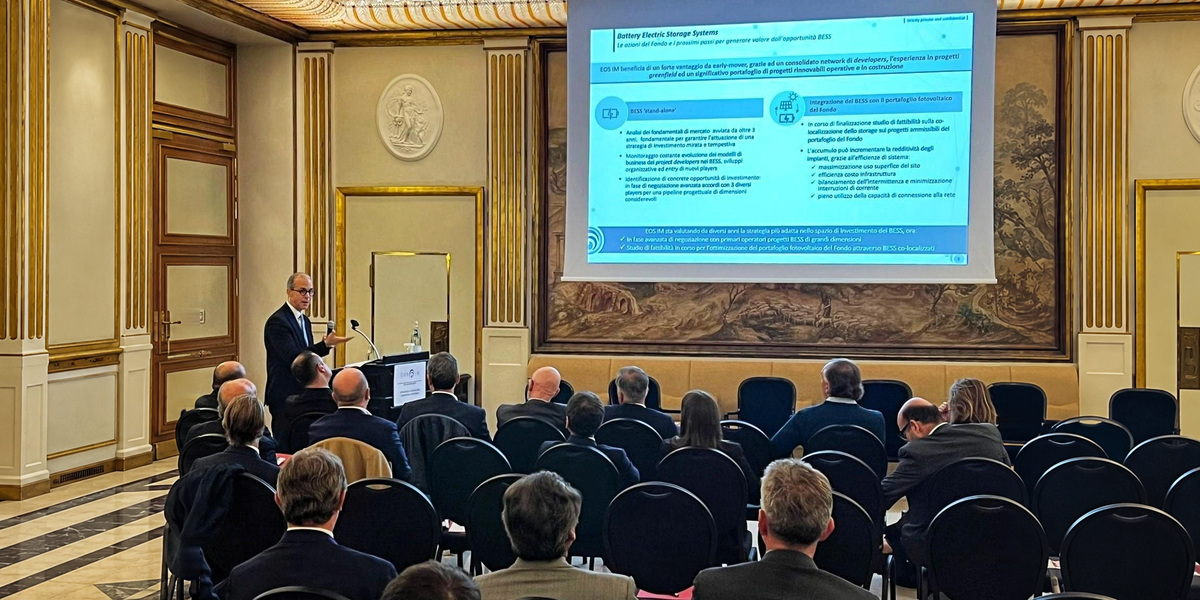
This is the territory in which Giuseppe La Loggia, Senior Partner at EOS Investment Management, has contributed to public discussion in specialist outlets such as Inspiratia and BeBeez Magazine, both of which focus on infrastructure finance and feature participants engaged in live transactions. He has focused his commentary on how renewable assets are financed and operated throughout their lifetimes, rather than on their initial construction. He has argued that this distinction matters more as the sector matures.
One recurring theme is the relationship between policy and private capital. Renewable expansion in Europe did not arise organically; it followed subsidy schemes, carbon pricing, and successive changes in market design. Institutional investors moved into the sector as those frameworks became more predictable and as fund managers developed contractual structures capable of absorbing merchant price risk. La Loggia has described that relationship in operational terms: policy can establish the conditions for investment, but it is private capital that scales those conditions into delivery at the pace governments require.
A related thread is grid parity, the point at which renewable generation competes with conventional power without subsidy. The concept gained currency in the mid-2010s as solar costs fell, but, in La Loggia’s analysis, the shift was never driven solely by technology. Falling panel prices were necessary but not sufficient. What allowed sub-parity projects to be financed was the redesign of the contracts around them: long-term power purchase agreements priced on a pay-as-produced basis, disciplined procurement that compressed the margins previously absorbed by EPC contractors, and asset management capable of meeting the performance assumptions on which long-term debt was sized. The Montalto di Castro portfolio in Italy, commissioned in 2017 and developed by funds managed by Octopus Investments during his tenure leading the renewables portfolio, is widely cited as the first European utility-scale solar plant to operate at grid parity.
Affordability has more recently re-emerged as a question of system design rather than of generation cost. Grid upgrades, storage, and balancing add to the total cost of integrating renewable supply, and weak grid capacity can stall otherwise viable projects. La Loggia has argued for investment models that hold consumer costs steady through pricing and contractual discipline rather than through further subsidy. Where the sector once depended on incentive design to make returns possible, the more durable approach now rests on contractual design that distributes risk between developers, financiers and offtakers in a way that survives market cycles.
A second strand of his commentary concerns land use. Solar projects compete with agriculture and other uses, particularly in southern Europe, where the climate makes both agriculture and solar power attractive. La Loggia has advocated for agrivoltaic models. These models integrate solar generation with ongoing agricultural activities on the same land. There is growing policy interest in this approach in Italy and Spain. This interest stems from land-use constraints that now pose a material development risk. Italy’s 2021 national recovery plan, submitted under the European Recovery and Resilience Facility, included dedicated support for agrivoltaic installations.
A consistent feature of his comments is caution about pace. Investors deploying capital over twenty- to thirty-year horizons need policy stability and predictable regulation more than they need new initiatives. Abrupt changes to incentive frameworks, retroactive regulatory adjustments, and unsettled market design raise the discount rates applied to renewable projects more than any movement in equipment costs. The volatility in European wholesale power prices after the 2022 energy crisis reinforced the point: the transition does not need to be accelerated through new instruments so much as the existing ones need to remain in place long enough to be relied upon.
The wider context for these contributions is a sector in which industry, finance, and policy are increasingly difficult to separate. Commentary from practitioners involved in live transactions tends to carry more weight than abstract advocacy, because the questions before policymakers, connection queues, balancing market design, the fiscal treatment of renewable income, are now operational rather than ideological. As renewable capacity continues to expand across Europe, the people shaping the practical answers are increasingly those, like La Loggia, with direct experience of building, financing and operating the assets around which the policy debate is organised.
Disclaimer: This article is intended for general informational and educational purposes only. The views and information presented are based on publicly available sources and industry perspectives and should not be considered financial, legal, or investment advice. Readers are encouraged to conduct their own research and consult qualified professionals before making any financial or investment decisions.