By: Frank Baraldini
Twenty-five years after 9/11, the question most people are asking is how to commemorate what happened. Scott Gibbs is asking a different one. Why does the pattern that produced the events of that day keep producing itself, in different forms, in different places, across different decades?
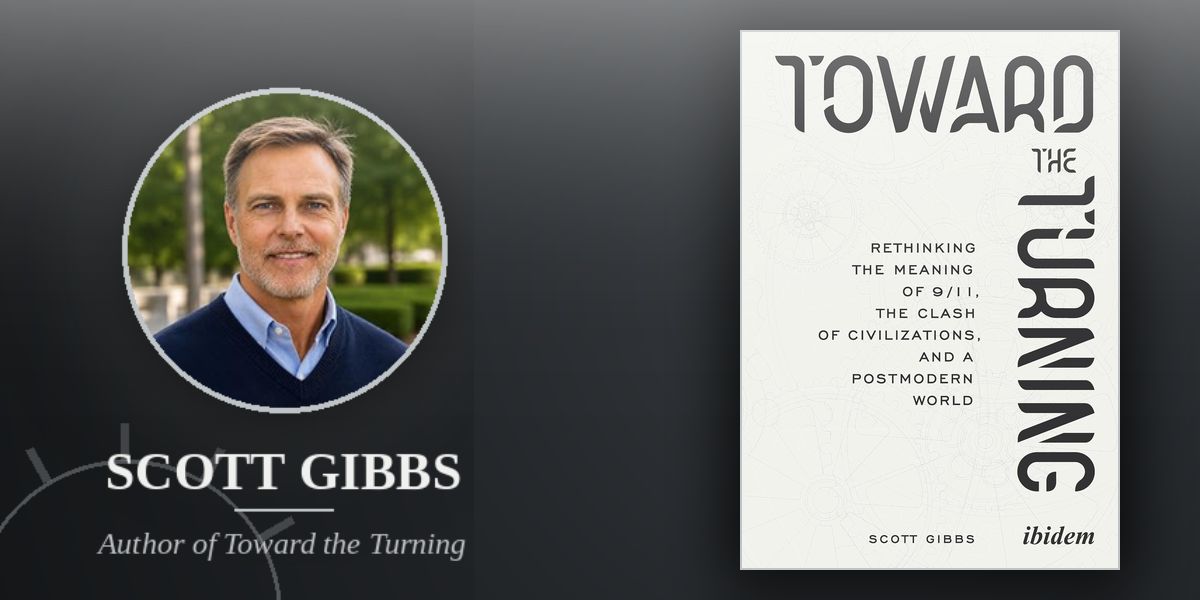
That question is the engine of Toward the Turning, his deeply researched and genuinely challenging book about identity, conflict, and what it would actually take to break cycles that seem almost structurally built to repeat.
Scott came to the book through a background in psychology and conflict resolution combined with a serious engagement with religion, philosophy, and existential thought. His starting point was Islam and Islamism, which eventually led him to a published article in the Journal of Humanistic Psychology. But conflict, he kept discovering, is relational. Understanding one side of it always required understanding the other. And that led him deeper into the West, into America, and into the question of why identity systems harden under threat in ways that make resolution so extraordinarily difficult.
The Faiths We Don’t Call Faiths
One of the book’s most generative moves is Scott’s decision to use the word faith broadly enough to include secular identity systems alongside religious ones. American Exceptionalism is a faith. The American Dream is a faith. Zionism is a faith. Each functions as a social compact that tells its members how to interpret the world, what matters, who they are, and what they may hope to receive in return.
That framing does something important. It puts religious fundamentalism and secular fundamentalism on the same analytical footing, as expressions of the same underlying dynamic rather than as categorically different phenomena. Both emerge when an identity system held as given reality comes under threat. Both produce the hardening, the defensiveness, the dehumanization of the other side that characterizes the deadliest conflicts of the modern era.
The Abrahamic faiths, Judaism, Christianity, and Islam, each get their own chapter in Scott’s framework, examined not as theological traditions primarily but as covenantal structures, compacts of demand and promise that orient believers toward a transcendent authority and make life meaningful and morally grounded. Each also contains the seed of its fundamentalist form when that system is threatened by modernity, by rival systems, or by the collapse of the authority that holds it together.
The American Polarization Connection
One of the most immediately recognizable applications of Scott’s framework is his analysis of American political polarization. He identifies two poles within American Exceptionalism, which he calls Ethnocentrism and Progressivism, as interdependent expressions of real tensions built into the American founding itself.
Ethnocentrism seeks restoration, order, loyalty, self-reliance, and national strength. Progressivism seeks transformation, inclusion, equity, and justice. Each begins with real concerns and addresses real dimensions of American experience. But at the extremes, each turns a partial understanding of America into the whole truth and then defends that partial truth with the intensity of someone defending their entire world. Because in a sense, that is exactly what they are doing.
Polarization in Scott’s framework isn’t simply policy disagreement. It is an interlocking pattern between rival political faiths, each of which sees the other as an existential threat rather than as a different emphasis within a shared tradition. The result is accusation, defensiveness, contempt, and dehumanization rather than the kind of problem-solving a functioning democracy requires.
And that pattern, he argues, mirrors and feeds tensions playing out at a global civilizational scale. Domestic polarization and international conflict are not separate problems. They are expressions of the same underlying dynamic at different scales.
What the Anniversary Reveals
As the 25th anniversary of September 11, 2001 approaches in 2026, Scott’s argument is that the attacks still matter as more than historical trauma. They reveal a recurring human pattern: identity systems harden under threat, leading to extreme and often counter-productive behavior that locks groups into cycles they cannot easily exit.
Understanding that pattern is not an argument for moral equivalence. It is an argument for the kind of clarity that might eventually make something different possible. That possibility, modest and difficult and genuinely hopeful, is what Scott calls The Turning. Not a solution imposed from outside. A shift in perception that begins with recognizing how all of us, not just the extremists, not just the other side, live through identity systems that shape what we see, fear, desire, and defend.
The hope isn’t that conflict disappears. It’s that we become more capable of humility, responsibility, and genuine connection across the divides that currently feel absolute. Twenty-five years after that September morning, that capacity feels more necessary than ever.
As the 25th anniversary of 9/11 approaches, Toward the Turning by Scott Gibbs is available now on Amazon. The events of that day were not just a historical moment. They were a window into a pattern that is still repeating itself today. This book explains why and what it would take to finally break it.