
In an era dominated by digital imagery, artificial intelligence, and endless visual content competing for attention, there is something almost shocking about standing in front of a Robert Leone portrait for the first time. People often pause longer than expected. They move closer. They study the texture of skin, the reflection in a lens, the folds of fabric, and the softness of smoke drifting through the composition. And eventually, almost everyone asks the same question:
“This is really drawn by hand?”
That reaction has become one of the defining characteristics of Leone’s work.
A self-taught hyperrealist artist originally from Queens, New York, and raised on Long Island, Robert Leone has quietly built a reputation for creating museum-quality graphite portraits that blur the line between drawing and photography. His works capture iconic cultural figures with extraordinary technical precision, but what truly separates Leone from many contemporary hyperrealists is not simply his attention to detail; it is emotion.
His portraits feel alive.
Every crease, shadow, texture, reflection, and expression carries emotional weight, transforming his work from a technical exercise into something deeply human. Whether drawing musicians, actors, or cultural icons, Leone approaches each subject not as an image to replicate, but as a personality to understand.
And perhaps that sensitivity comes from the way his own artistic journey began.
Leone discovered drawing at a young age while recovering from a medical condition. Armed with little more than a #2 pencil and a notebook, he began sketching faces from magazines, album covers, and books. During a difficult period of his life, both music and art became forms of escape, creative spaces where emotion, imagination, and identity could exist freely.
That emotional connection to music still plays a central role in his artistic philosophy today.
“Music has been the backdrop of my life for as long as I can remember,” Leone explains in his artist statement. “These are figures that carry real emotional weight.”
That sentence says a great deal about the foundation of his work.
For Leone, portraiture is not simply about resemblance. It is about presence. The challenge is not only to recreate someone’s face accurately, but to capture the details that make them unmistakably themselves, the expression in their eyes, the texture of a leather jacket, the mood carried through posture, accessories, fabric, smoke, or light.
This obsessive commitment to realism requires immense patience and discipline. Leone works primarily in graphite pencil, pushing the medium to extraordinary limits. Every detail is carefully layered and refined until the final image feels almost photographic in its precision.
But despite the technical mastery, his work never feels cold.
That is what makes it compelling.
Many hyperrealist artists focus so heavily on perfection that emotion disappears from the work entirely. Leone manages to achieve both simultaneously. His portraits maintain soul beneath the realism. Viewers are not simply impressed by the technique; they feel connected to the subject itself.
That emotional accessibility has helped his work resonate strongly with collectors and audiences across galleries and art fairs throughout the United States. His originals have become sought after for their craftsmanship, while select pieces are also available as limited-edition fine art prints.
Yet Leone’s path into fine art was far from traditional.
After earning degrees in Economics and Graphic Design from Binghamton University in 1994, he spent years working within New York’s financial sector. Like many creatives, I found that practical life responsibilities temporarily pushed art into the background. But sometimes artistic passion waits patiently for the right moment to return.
For Leone, that moment arrived through a museum visit.
Seeing Chuck Close’s legendary Big Self-Portrait at the Museum of Modern Art reignited something inside him. The scale, realism, and obsessive detail of Close’s work deeply impacted Leone and sparked his fascination with hyperrealism as a serious artistic pursuit.
Years later, in 2014, he completed Clarence, his first finished piece in years – a work that marked not only a return to art, but the beginning of an entirely new chapter in his life.
Since then, Leone has continued refining his artistic language with remarkable dedication.
Now based in Fort Lauderdale, Florida, he creates portraits that feel timeless in a world obsessed with speed. There is almost a meditative quality to his process. In many ways, his work challenges contemporary visual culture itself. At a time when images are consumed and forgotten within seconds, Leone creates pieces that demand stillness and attention.
The viewer cannot rush through them.
Every detail asks to be studied.
Every texture rewards patience.
And perhaps that is exactly why his work feels increasingly important today.
Beyond the realism itself, Robert Leone’s art reminds audiences of the emotional power of craftsmanship. In a digital age where so much creativity feels temporary and algorithm-driven, his portraits stand as evidence of something slower, deeper, and profoundly human – the ability of one person, armed with nothing more than graphite and patience, to create images that feel unforgettable.
His work does more than reproduce faces.
It preserves presence.
And that distinction is what elevates Robert Leone from a technically gifted draftsman into something far more significant, an artist capable of making viewers stop, feel, and truly look.
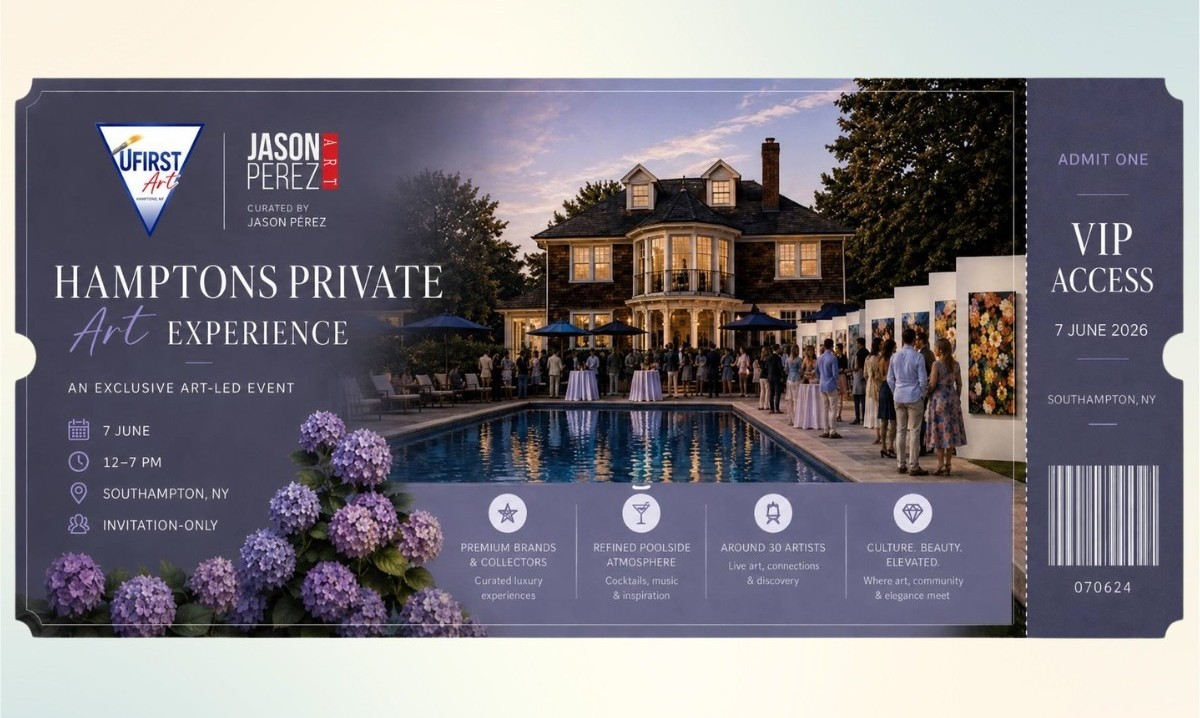
The artist’s work will be featured at the upcoming Hamptons Private Art Experience on June 7, 2026, in Southampton, New York, an invitation-only gathering produced by Jason Perez and UFIRST Art Production. Set within a private Hamptons estate, the experience brings together collectors, tastemakers, and high-net-worth guests for an elevated evening where contemporary art, curated networking, and refined summer lifestyle converge in an intimate collector-focused setting. Unlike traditional exhibitions, the event is designed to create meaningful access between artists and collectors, positioning each work within a sophisticated cultural atmosphere shaped by exclusivity, conversation, and artistic discovery.