By: Alva Ree
In an age where so much of life is defined by rules, labels, and expectations, artist Evan Hammer has chosen a different path, one where creativity is free to move in any direction.
Known to friends simply as “Hammer,” the New York-based artist has spent a lifetime exploring the intersection of imagination, movement, music, and visual expression. His work resists traditional definitions, inviting viewers into a world where paintings can be viewed from any angle, stories have no fixed beginning or end, and creativity becomes a living conversation rather than a finished statement.
For Hammer, art was never a career choice; it was a natural extension of who he is.
“The art force runs strong in my family,” he explains. “My grandmother had it, my mother had it, my uncles had it. It was never forced on me. I knew no other way.”
Growing up surrounded by creativity, he witnessed firsthand how artistic expression could evolve over time. His mother created soft sculpture dolls and constantly reinvented her artistic voice, while his father, an architect and builder, brought structure, geometry, and discipline into the household. Together, they formed a powerful balance of imagination and design that continues to influence Hammer’s work today.
“I guess I chose the perfect parents,” he says with a smile.
As a child, he spent much of his time at arts and crafts festivals, running through fields filled with artists, makers, and creators. Even then, he was drawn less to convention and more to possibility. While other children focused on comic book battles, Hammer studied anatomy and proportions, sketching figures from his older brother’s superhero collections.
That curiosity would eventually evolve into a lifelong exploration of form, movement, and visual storytelling.
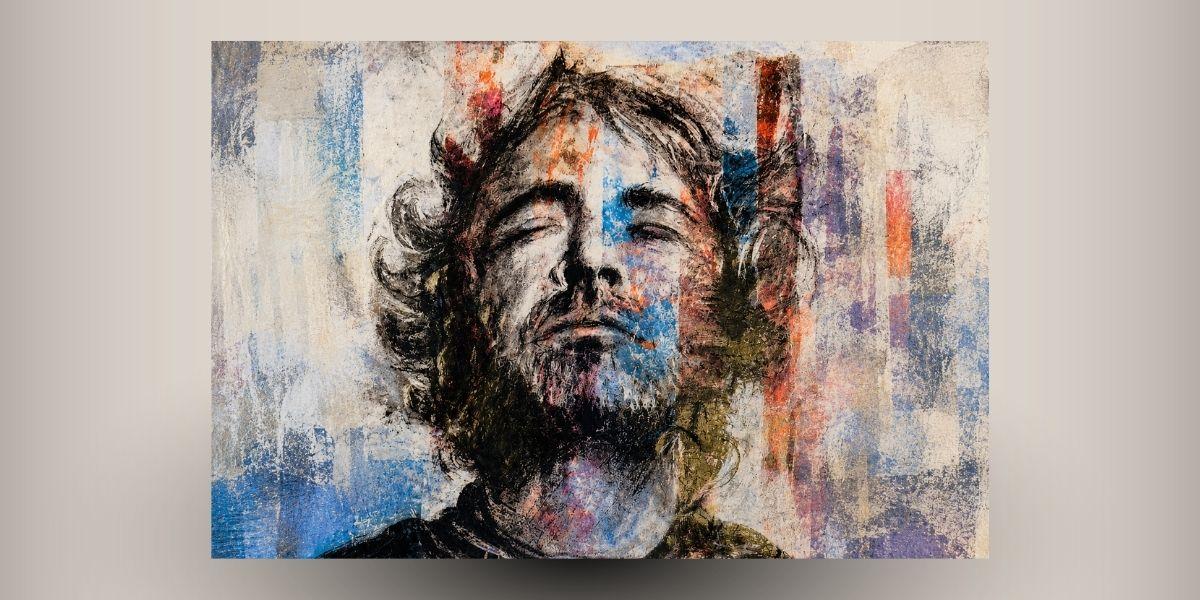
Today, Hammer is best known for what he calls “Printpaintings” a distinctive body of work that combines printmaking processes with the emotional energy of Abstract Expressionism.
Years ago, he worked in the tradition of masters such as Kandinsky and De Kooning, creating large-format non-objective paintings. Yet over time, the traditional painting process began to lose its spark.
“I grew tired of the oil and turpentine,” he recalls. “I lost the urge to paint, which was once my favorite thing to do.”
The breakthrough came unexpectedly while teaching high school art.
When printmaking materials arrived in the classroom, Hammer would cover tables with large sheets of paper and encourage students to experiment freely, rolling ink, stamping textures, finger painting, and leaving spontaneous marks behind. What began as classroom preparation soon revealed itself as something much more meaningful.
The resulting surfaces became collaborative visual landscapes, layers of color, texture, movement, and energy created by multiple hands. Hammer later developed these backgrounds into finished works, discovering an entirely new artistic language.
The process reminded him of the spirit of street art, where one artist responds to another and creativity unfolds as an ongoing conversation. Rather than directing viewers toward a single interpretation, his work encourages them to create their own.
“Art can be anything,” Hammer says. “There are no restrictions. Imagination is free of time and the limitations that keep us grounded.”
This philosophy extends even to the way his paintings are displayed.
Many of his recent works are created flat on a table, with no designated top or bottom. Instead of signing them traditionally, he often uses a symbol resembling his initials, allowing the piece to be rotated without appearing upside down.
For Hammer, changing the orientation of a painting creates an entirely new experience.
“Why not rotate it on your wall when you’re ready for a new story?” he asks.
Yet perhaps the most remarkable chapter of Hammer’s journey is not artistic; it is personal.
Despite spending decades immersed in creativity, he eventually encountered something many artists know well: creative stagnation.
As a high school art teacher, he remained surrounded by art every day, but the inspiration that once fueled him seemed distant. Years earlier, he had traveled through Europe with a sketchbook in his pocket, studying great masters in museums and documenting everything around him. Over time, that passion faded.
The turning point arrived through an unexpected source: health and self-discovery.
Instead of traveling to museums, Hammer began traveling to surf destinations. The ocean became both teacher and mirror. Life delivered its own lessons through setbacks, personal challenges, and moments of humility.
A transformative trip to Peru, combined with a renewed focus on wellness, helped him reconnect with himself. He embraced practices such as yoga, breathwork, sound healing, Reiki, fasting, and a vegetarian lifestyle.
Most importantly, he learned to let go of judgment.
“Freeing myself from judgment was the real key to unlocking true happiness in the creative process,” he says.
One quote, painted on his classroom wall by a student, continues to guide him:
“The enemy of creativity is self-doubt.”
That realization changed everything.
Today, Hammer approaches art not as a destination, but as a practice of presence.
His goals have evolved as well. Where once his work centered primarily on personal expression, he now seeks collaboration, community, and shared experiences.
For more than fifteen years, he has served as Art Director for Bradstock, a beloved family-friendly music festival supporting Camp Pa-Qua-Tuck. Each year, Hammer leads a team of artists and volunteers in designing immersive stage environments unlike anything seen before.
The festival reflects a deeper truth about his work: creativity becomes most meaningful when it serves something larger than the individual.
“If there is no vision or deeper purpose,” he says, “I lose interest and seek connection elsewhere.”
That search for connection continues to expand through music.
In addition to his visual art practice, Hammer performs with several musical projects, including Squid and the Wave Chasers, The Boot, and the experimental improvisational collective Funamungus. Whether playing guitar, bass, or any instrument he can get his hands on, he approaches music with the same openness that defines his artwork.
His most ambitious multidisciplinary work emerged recently at Art Expo New York, where Funamungus performed alongside artist and performer Joe Stublick during a live improvisational experience known as The Invisible Line. Music, painting, movement, and audience interaction merged into a spontaneous creative dialogue where each element influenced the others in real time.
For Hammer, it represented the culmination of a lifetime spent exploring the relationship between art and experience.
“This is the most unique and expressive output,” he says. “Something I feel I’ve been training for my whole life.”
Looking ahead, Hammer plans to continue developing his Printpaintings while integrating original music into his visual presentations through his growing YouTube channel. As always, he remains committed to experimentation, collaboration, and the freedom to evolve.
His work reminds us that creativity is not about perfection. It is not about following rules or finding a single correct answer.
It is about staying curious.
About remaining open.
About allowing imagination to move freely, without boundaries.
And perhaps most importantly, it is about having the courage to keep creating even when the canvas has no top, no bottom, and no predetermined direction.