Broadcom will develop and supply custom ASIC silicon for Apple through 2031 under a new multi-year agreement disclosed on July 6, 2026, extending one of the technology sector’s most established supplier relationships. Broadcom shares climbed on the announcement, which secures a long-term revenue stream from the company’s largest customer and reinforces Apple’s dependence on outside silicon partners.
Key Takeaways
- Broadcom and Apple agreed to expand their collaboration through 2031, with Broadcom developing and supplying custom ASIC silicon for use across multiple generations of Apple products.
- The deal was disclosed in a Broadcom filing with the U.S. Securities and Exchange Commission on July 6, 2026.
- Broadcom shares rose roughly 4% to 5% on the news, contributing to a rebound in chipmakers after a two-day selloff.
- Apple accounts for approximately 20% of Broadcom’s revenue, making the extension a meaningful anchor for the semiconductor supplier.
What Did Broadcom and Apple Announce?
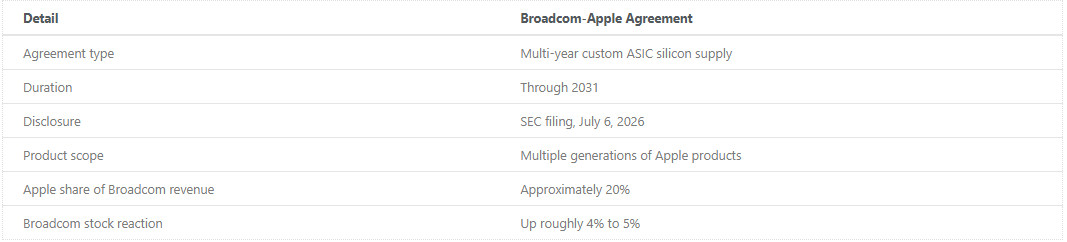
Broadcom and Apple confirmed a new set of long-term agreements under which Broadcom will design and supply a range of custom ASIC silicon products. ASIC stands for application-specific integrated circuit, meaning the chips are built for a defined purpose rather than general computing. In its SEC filing, Broadcom stated that the two companies agreed to expand their collaboration through 2031 for Broadcom to develop and supply custom silicon “for use in multiple generations of Apple products.”
The arrangement covers future Apple devices without naming specific models or product lines. Financial terms of the extension were not disclosed. The agreement gives Broadcom long-term visibility into one of its most valuable customer relationships, while giving Apple continuity of supply as it plans hardware years in advance.
How Long Have Broadcom and Apple Worked Together?
Broadcom has supplied Apple with components for years, primarily connectivity and radio-frequency parts. These include radio-frequency chips that let iPhones connect to cellular networks, along with Wi-Fi and Bluetooth connectivity chips and other networking semiconductors. That established base is what the new agreement builds on, moving the relationship further into custom-designed silicon.
Apple has invested heavily in developing its own in-house chips, including its C1 modem, as it works to reduce reliance on external suppliers. Even so, Apple continues to depend on Broadcom for wireless and radio-frequency components, an area where Broadcom holds a technical position that is difficult to replicate quickly. The extension signals that Apple’s internal silicon push and its outside partnerships are running in parallel rather than replacing one another.
Why Does the Deal Matter to Broadcom Financially?
Apple is Broadcom’s largest customer, representing close to 20% of the company’s annual revenue. Locking that relationship in through 2031 removes a significant source of uncertainty for Broadcom investors and provides a predictable revenue base as the broader semiconductor market shifts toward artificial intelligence hardware.
Broadcom’s stock responded immediately. Shares gained roughly 4% to 5% during the session, trading around $380, according to market data from RTTNews and Invezz. The stock has risen more than 30% over the past year as the artificial intelligence boom fueled demand for more semiconductors. Beyond Apple, Broadcom has been expanding its custom-chip work with other large technology firms, including Alphabet and Meta Platforms, developing AI-specific silicon for their data-center operations.
How Did the Market React?
The Broadcom announcement landed on a day when semiconductor stocks were recovering from a two-day decline. The rebound helped lift the technology-heavy Nasdaq 100 by roughly 1.5% on the session, with sentiment supported by broader optimism around AI hardware demand. Broadcom’s advance was among the stronger single-stock moves within the chip group.
What Does the Extension Signal for U.S. Semiconductor Supply?
For the U.S. technology sector, the agreement reflects continuity in a domestic supplier relationship at a moment when semiconductor supply chains draw heavy scrutiny. Apple’s decision to secure a range of custom chips years in advance points to the strategic value companies now place on locking in reliable silicon sources. The move also underscores how central custom ASIC design has become, both for consumer devices and for the AI infrastructure that Broadcom supplies to other major firms.
The extended Broadcom-Apple partnership gives both companies a defined path through the end of the decade, tying a decades-long supplier relationship directly to the next generation of Apple hardware.
FAQs
What is the Broadcom-Apple agreement? Broadcom agreed to develop and supply custom ASIC silicon for Apple through 2031. The deal was disclosed in a Broadcom SEC filing on July 6, 2026, and covers multiple generations of future Apple products.
What are ASIC chips? ASIC stands for application-specific integrated circuit, a chip designed for a particular function rather than general-purpose computing. These chips are built to specification for a defined use.
How much is the deal worth? Broadcom and Apple did not disclose the financial terms of the extension. However, Apple accounts for roughly 20% of Broadcom’s annual revenue.
How did Broadcom’s stock react? Broadcom shares rose about 4% to 5% following the announcement, trading near $380. The stock has gained more than 30% over the past year.
Does Apple still make its own chips? Yes. Apple has developed in-house silicon, including its C1 modem, but continues to rely on Broadcom for wireless and radio-frequency components.
What other companies does Broadcom supply? Broadcom develops AI-specific chips for other large technology firms, including Alphabet and Meta Platforms, in addition to its long-standing work with Apple.