
A new wave of actors is reshaping what independent film looks like. They come from multilingual backgrounds, move fluidly between stage and screen, and build their careers on the international festival circuit rather than through traditional Hollywood routes. Wasim Azeez belongs to that group.
Working across film, television, and theater, Azeez has built a body of work rooted in characters that resist easy categorization. His films have collectively screened at more than 25 festivals worldwide, and his stage work recently earned him a Best Performance nomination (Off-Off Broadway) at the American Theater of Actors for a production voted Best Show of 2025 by TheaterScene. He also stars in an internationally recognized television pilot that has screened across India, Canada, and the United States, with nominations at the NYC WebFest and LA WebFest.
In this conversation, Azeez discusses the range of characters he has played, the festival journey that has carried them, and the leading role he is about to take on.

How Does Wasim Azeez Approach Characters Across Languages?
Q: You work across film, television, and theater, and across languages. How does moving between those worlds shape the way you approach a character?
Wasim Azeez: Moving across film, television, and theater, and between languages, keeps me grounded in specificity. In Alone Alone on a Wide Wide Sea, I played a Tamil-speaking man trying to save his younger brother from addiction. In The Apple Picker’s Son, I stepped into the life of a Kashmiri migrant worker navigating survival and protecting his family during unrest. And in Debt I Owe, I played a Pakistani immigrant, in Urdu, battling a gambling addiction.
Wasim Azeez: Each role comes with its own cultural rhythm and emotional reality, and I have to meet it on its own terms. Bringing these distinct, lived-in stories to audiences, especially in the U.S., has been surreal because it shows how deeply personal stories can still connect across cultures when they are told honestly.
The three projects Azeez names point to a deliberate pattern in his filmography. Each role asks him to inhabit a different community, language, and emotional register, a range that is uncommon for actors at his career stage, who more often settle into a single lane early.
What the Festival Circuit Has Taught Him
Q: Your work has screened at over 25 film festivals worldwide. How has that journey shaped you as an actor?
Wasim Azeez: The festival journey has taught me to trust the work more than anything else. You start to see how different audiences respond, and what actually connects. It is rarely scale, it is honesty. I remember during a screening at Dance With Films, an Irish gentleman came up to me after The Apple Picker’s Son and said the story reminded him of what his grandfather went through during unrest in Ireland, how his family barely survived, and how many didn’t.
Wasim Azeez: That stayed with me. On the surface, Kashmir and Ireland are very different, but the emotional truth of family, survival, and loss was the same. Moments like that remind me that if a story is specific and real, it can travel far beyond where it comes from.
Q: With your work reaching multiple Oscar-qualifying festivals and a BAFTA-qualifying platform, how do you view that recognition in terms of your growth as an actor?
Wasim Azeez: It is definitely encouraging, but I try not to let that kind of recognition define the work. For me, it is more of a sign that the projects are finding the right platforms and audiences. What it does give me is a level of responsibility to keep choosing stories that hold up to that standard of honesty.
Wasim Azeez: In terms of growth, it pushes me to go deeper. You cannot rely on surface-level choices when the work is being seen on that scale. It has made me more intentional about preparation and more selective about the roles I take, because ultimately the goal is to keep evolving, not just accumulating credits.
Recognition at qualifying festivals can tempt actors to chase accolades rather than the next right role. Azeez’s response points the other way. For him, the festivals function as a pressure test, setting a standard that the work itself then has to meet.
Inside His Approach to Preparing a Role
Q: What does your preparation look like when you take on a new role?
Wasim Azeez: One of the first things I do when preparing for a role is immerse myself in the character’s world beyond the script. I often watch YouTube videos of local guides or people from that community giving tours of their cities and neighborhoods. You can learn so much from that, from their mannerisms, how they speak, what they are most proud of, what frustrates them, even what they choose to show an outsider first.
Wasim Azeez: Those details tell you how a person sees their world. It helps me understand not just the accent or dialect, but the emotional texture of where they come from. Then I build the character from there, grounding it in behavior, rhythm, and lived experience rather than just lines on a page.
The approach is unorthodox and effective, especially for an actor whose roles require moving between cultural contexts. It also reflects a generation of performers who treat the internet as primary research material rather than a secondary reference, and Azeez appears to have built a working method around it.
Stepping Into a Leading Role
Q: With a strong festival run behind you, what are you focused on next?
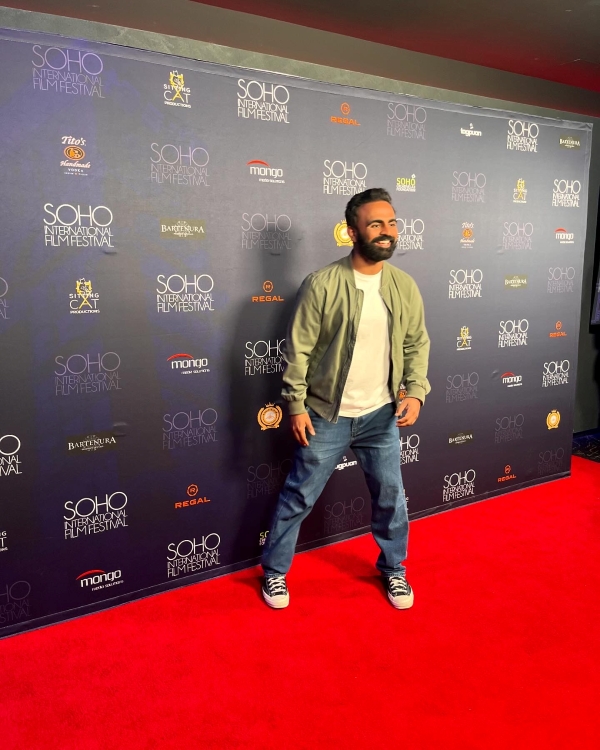
Wasim Azeez: I am focused on building on that momentum by stepping into more responsibility as a lead. I have an upcoming indie feature releasing this spring where I am carrying the story, and that has been an important shift for me. It is about taking everything I have learned, from festival work, from different cultures and characters, and applying it at a deeper level.
Wasim Azeez: At the same time, I am being more intentional about the kind of stories I say yes to. I am looking for work that has weight to it, characters who are navigating something real, because that is where I feel the most growth happens.
Carrying a feature film is a significant step up, one that asks an actor to hold an audience’s attention across an entire narrative arc. Based on the selectivity Azeez describes, he has been preparing for that kind of demand for some time.
The Kind of Stories Worth Telling
Q: What kind of stories are you hoping to tell moving forward?
Wasim Azeez: I’m drawn to character-driven stories where ethnicity is part of the world, but not the defining limit of who the character is. I want to play roles that are complex, flawed, funny, and unexpected. People first, not categories. For me, it is about expanding the range of who gets to exist on screen and stage in fully realized ways, without being reduced to a single lens. That is the kind of work I want to keep moving toward.
Q: The piece is framed around a new wave of storytelling. Where do you see yourself within that shift?
Wasim Azeez: Across the festivals I’ve attended, there’s been a genuine curiosity from audiences to understand stories from different diasporas. That response has been really affirming. It shows that there is an appetite for narratives that feel specific and rooted in lived experience. I have also had the privilege of working with some fantastic emerging storytellers who are pushing that space forward in exciting ways.
Wasim Azeez: At the core of it, I really believe that if it is honest on the page, it will translate on stage or screen. That has always been my guiding principle when I approach a project.
Azeez’s answer closes a loop that runs through the entire conversation. Specificity. Honesty. A trust that the right details will carry a story across borders. That philosophy has shaped the work so far, and if the upcoming spring release is any indication, it is about to shape his next chapter, too.