

Most owners first learn the true price of a fast loan from their bank account, a few months too late. So let’s write the bill in advance. Below is an itemized invoice for a fictional 24-hour loan, line by line, showing what you’re charged, why, and how to reduce each item.
The example is illustrative. Actual pricing depends on your business, the provider, and the product.
The Scenario
Borrower: Ashford Print & Sign, three years in business, $65,000 average monthly deposits.
Need: $40,000 to purchase materials for a large signed order.
Timeline: Next day.
Offer: $40,000 repaid weekly over 40 weeks.
The Invoice
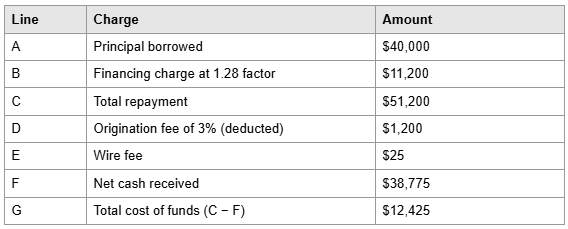
Now let’s look at each line.
Line B: The Financing Charge
A factor rate of 1.28 multiplies the loan amount: $40,000 × 1.28 = $51,200. Unlike interest on a declining balance, this is usually fixed from day one.
How to reduce it: Compare competing offers, shorten the amount you need, or improve your bank statements before applying. A strong file with a clean deposit history might receive a meaningfully lower factor. Before you sign, you can check your own figures in a tool such as the Fundivi total-cost calculator, then repeat the calculation with a second method.
Line D: The Origination Fee
Origination fees are commonly deducted from the amount you receive. So although the contract shows $40,000, you get less, and you still repay the full $51,200.
How to reduce it: Ask. Origination is sometimes negotiable, particularly with a competing offer. And be sure to ask if a broker’s commission is included in this fee or added separately.
Line E: Small Fees
Wire, ACH, platform, and “administrative” fees may seem trivial but they accumulate. Look for:
• Underwriting or application fees
• Monthly account or servicing fees
• UCC filing fees
• Returned payment charges, often $25 to $50 each
• Late fees
How to reduce them: Request a complete fee schedule, and keep enough money in your account to prevent returned payments.
Line G: The Real Price
Ashford receives $38,775 and repays $51,200. The cost of having that money is $12,425, which is 32% of the net proceeds. That’s before you take time into account.
Converting the Bill to an Annual Rate
The money isn’t held for a full year. In fact, Ashford’s balance declines each week as it repays. So its annualized cost is significantly higher than 32%.
Weekly payment: $51,200 ÷ 40 = $1,280.
If you run these cash flows through an APR formula, the result is roughly 74% when you use net proceeds, and it varies with how fees are treated. Published APRs can differ by method, so treat this as an approximation.
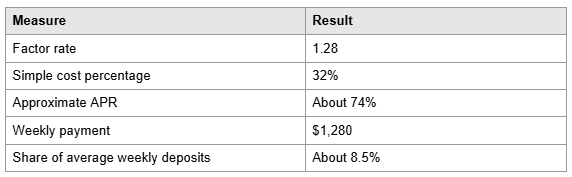
This is why the headline number can be misleading. A factor rate of 1.28 and an APR near 74% describe the same loan.
The Costs Not on the Invoice
Some expenses never appear on the contract, yet they’re real.
Cash flow strain. Paying $1,280 weekly means that money isn’t available for other purposes. If you end up delaying payment to a supplier and losing a discount, that’s a cost.
Returned payment risk. A single bounced debit could lead to bank fees plus lender fees.
Lost prepayment value. If a fixed-cost loan offers no early payoff discount, you won’t save anything by repaying early.
Lien effects. A UCC blanket lien could block you from getting cheaper financing while the loan is active.
Time. Managing a daily or weekly debit calendar takes attention away from your work.
How Term Affects What You Pay
Compare the same $40,000 under several structures.
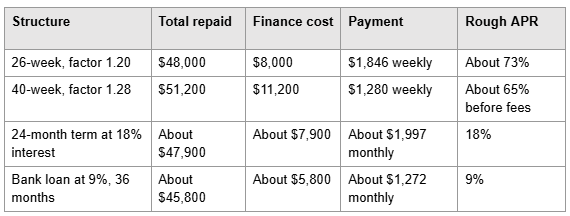
These numbers are examples, and they show why term, frequency, and rate must all be considered. Some lenders are also expanding the kinds of products they offer. A merchant with card-heavy sales might review this Macau Business summary of card-sales loans, keeping in mind that its costs must be analyzed the same way.
What Speed Is Worth
Ashford’s order pays $70,000 in 60 days with a gross profit of $30,000. Compared with that gain, a $12,425 cost is meaningful, but it still leaves about $17,575 of profit that it might otherwise have lost. So paying a premium could make good sense.
Now change the story. Suppose the same money would be used to cover payroll during a slump, with no specific revenue attached. Ashford would then be spending $12,425 simply to postpone a problem.
Before accepting, write these figures side by side:
• Cost of funds: $______
• Gross profit produced or protected: $______
• Probability that profit actually happens: ______%
Multiply the middle two, and compare the result to the cost. Some publications explain how this works for particular lenders, and a list of unsecured small business loans can give you an idea of what else is out there.
Reducing the Total Bill
Here are the moves most likely to shrink your final cost:
• Borrow less. Each dollar not borrowed saves you its full financing charge.
• Compare at least two offers on total cost, not on payment size.
• Ask about early payoff in writing.
• Negotiate the origination fee.
• Choose a less frequent payment if your cash flow benefits.
• Check slower options if the deadline isn’t truly firm.
• Plan a refinance into a less expensive product once your statements improve.
Asking the Right Questions
Before you sign, ask for these figures in writing: the exact amount deposited, the total repaid, the number and size of payments, all fees, the estimated APR, the early payoff amount at 30 and 90 days, and the circumstances that trigger default. Comparison websites such as SameDayBusinessLoansOnline.com can give you a frame of reference, but the only numbers that count are those in your signed agreement.
Costs Grow With Each Renewal
Providers may offer to renew a fast loan after you’ve paid down part of it. Be cautious, because fees are often charged on the new, larger balance. Suppose Ashford owes $20,000 after 24 weeks and accepts a new $40,000 loan. It would net only about $20,000 in new money after payoff, minus fresh fees, yet it would pay a financing charge on the entire $40,000. Repeating this pattern is how a single fast loan turns into years of costly debt. Before renewing, calculate what you’d pay on the fresh cash alone.
Frequently Asked Questions
What’s a typical factor rate for a 24-hour loan?
Often between 1.15 and 1.50, depending on risk and term. Some products fall outside that range.
Is a factor rate the same as interest?
No. A factor rate fixes the total cost at the start, while interest usually accrues on a declining balance.
Are fees negotiable?
Sometimes, especially origination fees. Competing offers strengthen your position.
Do I have to be told the APR?
In certain states and for certain products, yes. Ask for it in any case.
Is fast funding always expensive?
Usually more than bank credit. An existing line of credit could be a cheaper fast option.
Can I deduct the cost on my taxes?
Business financing costs are often deductible, subject to rules. Ask a tax professional.
Why is my quoted APR so high?
Short terms and frequent repayments mean you hold the full amount only briefly, which raises the annualized rate.
Should I always pick the lowest APR?
Not necessarily. Consider total dollars, payment size, and whether the money will arrive in time.
Is the first payment due right away?
Often within days, so plan your cash accordingly.
How can I spot hidden fees?
Request a written fee schedule and match it line by line against your contract and your net deposit.
Can a cost estimate change after approval?
Yes, if verification changes the file, so confirm final figures before signing.
Disclaimer: This article is provided for general informational and educational purposes only and does not constitute financial, lending, credit, tax, legal, investment, or business advice. Financing costs, factor rates, interest rates, fees, repayment schedules, annualized costs, and other terms vary by lender, product, borrower qualifications, and applicable laws and regulations. Any figures, calculations, examples, or comparisons in this article are illustrative only and should not be interpreted as a quote, guarantee, or representation of the terms available to any particular business. Readers should independently verify all financing terms with the relevant provider, review the complete agreement before signing, and consult qualified financial, tax, legal, or business professionals regarding their specific circumstances.