
By: Matthew McFilt
The Day Nobody Tells You About
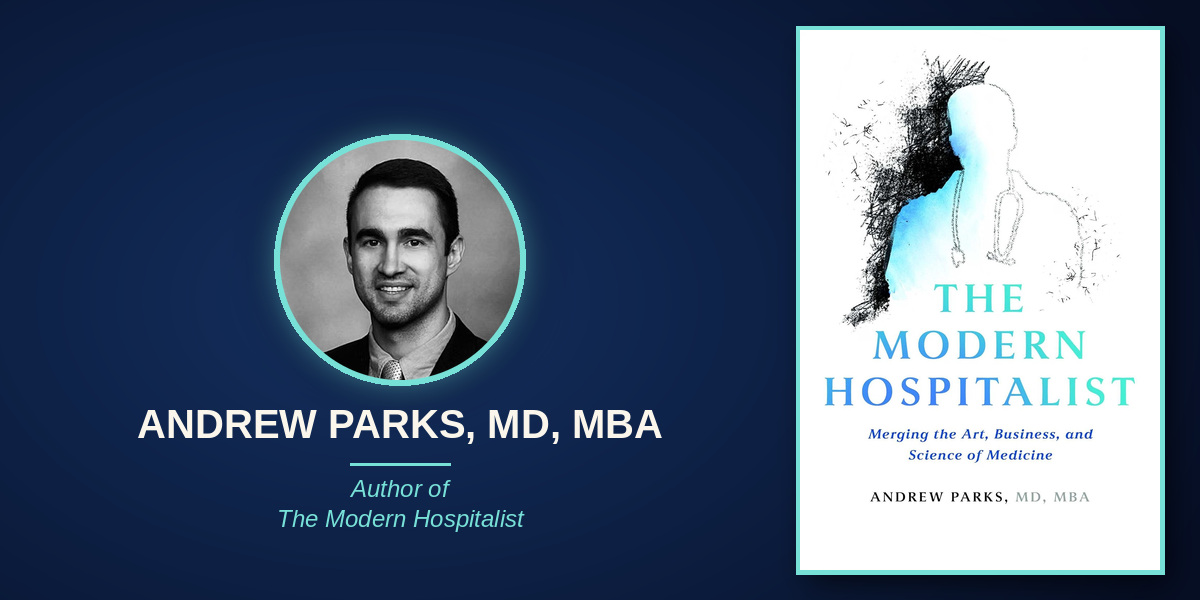
A few weeks into his first job as an attending hospitalist, Andrew Parks started a shift with twenty-two patients, roughly half of them needing progressive or ICU-level care. A newly intubated patient with a lung mass began bleeding into the airway. Stabilizing and transferring that patient took his entire morning. He had not seen most of his other patients before the next crisis paged him. On the outside, he tried to look calm. Inside, his perfectionism was telling him he had to handle all of it himself. As a resident, he’d once been told by an attending that calling for help was a sign of weakness, and he had absorbed that message more completely than he realized. What saved that day was not a resource or a protocol. It was a colleague who noticed he was drowning and offered to take one of his admissions. That small act taught him something no curriculum had: medicine is too complex for any one person to manage alone. The Modern Hospitalist: Merging the Art, Business, and Science of Medicine is his attempt to hand that lesson, and everything that followed from it, to the physician starting out today.
Three Strands, Not One
Andrew holds both an MD and an MBA, which remains an unusual combination in clinical medicine, and the dual background gave him a framework that shapes every argument in the book. Medicine, he writes, is a three-stranded rope: the science of diagnosis and treatment, the business of how the system functions and sustains itself, and the art of the human relationship between physician and patient. Medical training focuses almost entirely on the science strand. The business strand and the art strand are left for physicians to discover on their own, usually after something has already broken. Andrew came at the rope backward. Because of his MBA, he always knew the business strand mattered. His blind spot was the art. For much of his training, he saw patients as problems to solve. When peers connected emotionally with patients, he quietly worried they were compromising their objectivity. What changed his mind was evidence. His highest patient satisfaction scores were for listening, not explaining. A patient who had been readmitted repeatedly finally stabilized after Andrew sat down and simply heard them out. The research in Compassionomics confirmed what he was seeing: compassion measurably changes outcomes. Science gives you mastery, he writes. Business gives you autonomy. The art gives you purpose. When one strand frays on a hard day, the other two hold the weight.
Rural Medicine Is Not Lighter Medicine
Andrew practices hospital medicine in his hometown in rural southeastern Kentucky, a world away from the academic medical centers where most physician leadership literature is written. What that setting taught him that training never did is what it means to practice without a safety net. At an academic center there is a subspecialist down the hall. In rural southeastern Kentucky there have been stretches without consistent GI or neurology coverage, and periods when the only pulmonologist was covering the ICU, clinic, consults, and procedures alone. Andrew learned to co-manage ICU patients. He started doing his own intubations, thoracenteses, and lumbar punctures. He learned to triage wisely, because sometimes the right answer is that a patient cannot be safely cared for in that setting. His group regularly leads their system in case mix index, the measure of patient complexity, because rural patients often show up later and sicker, with several advanced conditions at once. Rural medicine is not lighter medicine. It is medicine practiced with fewer resources and higher stakes, and no standard textbook prepared him for it.
What Burns Out a Brilliant Physician
The erosion of values in a physician’s early career rarely announces itself. Andrew describes it in precise sequence. The first value to go is usually presence. A doctor starts rounding on patients instead of with them, still competent and kind but half in the room, already thinking about the next admission or the unsigned note. From the inside, it feels like efficiency. Next goes the sense of the whole life outside the hospital. Andrew worked on his days off, took calls at ballgames, and agreed to meetings on holidays, telling himself it was dedication. The quietest erosion is meaning. A physician stops asking why they chose medicine because they are too busy surviving it. Burnout rarely announces itself. It shows up as small shortcuts, a little less effort, and not quite recognizing the person you have become. Andrew experienced a version of it as an athlete after his knee injuries. Watching game film later, he could see he had been emotionally checked out long before he would have admitted it. The early warning signs are irritability, cynicism, and feeling like a cog. The most common reaction is to distance yourself to protect your objectivity. That distance, he argues, almost always makes things worse.
What He Wants a First-Year Hospitalist to Feel
Andrew is specific about what he wants a reader to take from The Modern Hospitalist. He wants them to feel less alone. The overwhelm, the second-guessing, and the sense that everyone else has it figured out are nearly universal, and feeling them does not mean a physician is failing. It means they are in the middle of becoming the physician they are meant to be. He also wants them to feel agency. The system is hard and he does not pretend otherwise, but understanding how it works through all three strands of the rope gives a physician leverage. They do not have to be a passive passenger. And he hopes they reconnect with their why. The parable of the three stonecutters stays with him. One is making a living. One is doing excellent work. One is building a cathedral. On the hardest days, he wants them to remember the cathedral. If this book changed how even one physician approached the work, by sitting down beside a frightened patient, asking a colleague for help, or staying in medicine when they were ready to walk away, he writes, it would be worth every hour he spent writing it. Because that one physician will care for thousands of patients over a career. That is how change actually happens in medicine.
Pick up your copy of The Modern Hospitalist: Merging the Art, Business, and Science of Medicine by Dr. Andrew Parks on Amazon today.
Disclaimer: The information presented in this article is for general informational and educational purposes only and should not be considered medical or professional advice. The views and opinions expressed are those of the individuals featured and do not necessarily reflect those of this publication. Readers are encouraged to consult qualified healthcare professionals for advice specific to their circumstances.