

Anyone with a Google account can tell Google Maps that a business has moved, changed its hours, or closed for good. If no one at the business is watching the listing, the owner may never hear about it. Google weighs that feedback and decides whether to update the listing, and many owners first notice a change in a slow month that never quite recovers.
That is how many businesses disappear from search results: not in one dramatic event, but gradually, through changes nobody announced.
Nothing Announces the Drop
Paid advertising is noisy by design. It sends invoices, dashboards, and alerts when a budget runs out. Organic visibility (the unpaid listings and search results a business earns over time) sends nothing when it slips.
Businesses that have disappeared from Google rarely find out from Google. Owners notice that the phone rings less and web inquiries thin out, and they reasonably blame the season or the economy. By then, the cause may be months old.
In practice, the fade usually comes from three places: changes to the business’s listing that the owner didn’t make, changes to the website that break how search engines read it, and changes to the results page itself.
When a Listing Changes Without the Owner
A Google Business Profile, the listing that shows a business’s hours, phone number, location, and reviews on Google Search and Maps, is not entirely the owner’s to control. According to Google’s Maps help pages, people familiar with a place can report it as temporarily closed, permanently closed, moved, or a duplicate of another listing, and that feedback helps Google decide whether to change its status.
An incorrect report, a duplicate listing that splits a business’s reviews in two, or a profile nobody at the business ever claimed can leave customers looking at the wrong information with no one in a position to fix it. In a market like Santa Clarita, where many customers drive to a business based on its listing, a wrong address or a “closed” label is enough to send them somewhere else. Edmond Abramyan, founder of Curious Fortune Media, a marketing agency based in the Los Angeles area, says the problem usually starts with how owners think about the listing.
“Most owners set up their listing once and never look at it again. It isn’t a sign on the door. It’s a living record that customers, Google, and other websites can all change,” Abramyan says. “By the time an owner notices something’s wrong, customers have usually been seeing it for weeks.”
Website Updates That Quietly Break Search
Websites change more often than listings, and some routine updates can take a business out of search without anyone noticing. A redesign that moves pages to new addresses without telling search engines where the old ones went can leave years of visibility pointing at pages that no longer exist. A setting used to hide a site while it is being built, if left on after launch, can tell search engines to skip the site entirely. Deleting an old service page can remove the one page that ranked for that service.
None of these looks wrong to a visitor. The pages load, and the design may be better than before. The damage shows up only in search.
Google offers a way to catch it. Through a free Google service called Search Console, Google reports on how it sees a site and sends alerts when it encounters indexing, spam, or other issues. Google’s own description says business owners should know about the service even if they don’t plan to use it themselves. It only helps if someone receives those alerts, and the account is easy to set up once and forget.
The Results Page Keeps Moving
Even when nothing is broken, the page a customer sees keeps changing. Ads, map results, and AI-written summaries now sit above many traditional listings, so a business can hold its place and still end up further down the screen. Google also adjusts how it ranks results. Google’s public list of ranking updates shows broad core updates in March, June, and December 2025 alone, and Google itself notes that a page can lose ground after one of these updates without anything being wrong with it.
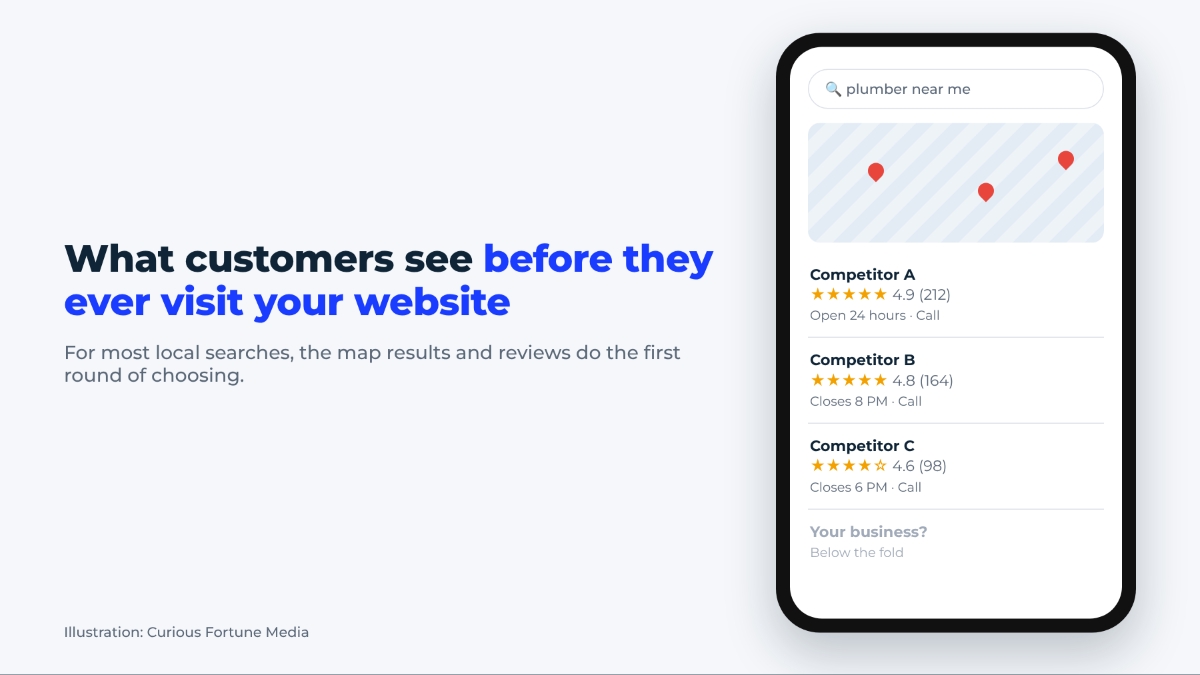
That is how a business can be technically present and still, in practical terms, disappear.
“Visibility isn’t something you earn once and keep,” Abramyan says. “The results move all the time, so the only safe assumption is that you have to keep checking you’re still there.”
Abramyan built the Authority Engine™ for Curious Fortune Media on that assumption. Its three layers, visibility, authority, and conversion, are treated as ongoing maintenance rather than one-time fixes, since the first can slip without warning.
A Monthly Check Owners Can Run Themselves
You can catch most of this in a few minutes a month. Searching for the business and its main services on a phone while signed out of any Google account shows roughly what a stranger sees. Opening the listing the way a customer would confirms the hours, address, phone number, and whether it still says the business is open. Confirming that someone at the business still controls the listing matters too, especially after staff turnover.
On the website side, someone should actually receive the Search Console alerts. Tracking where calls and inquiries come from, even in a simple log, can turn a slow quarter into a visible change within weeks.
None of this means every slow month is a search problem. Seasons and markets shift, and no one can promise a business a fixed position in search results. But businesses rarely vanish from search all at once. They fade gradually, and only someone who checks sees it.
An editable listing is a reason to look, not a reason to panic. For most owners, the first look takes less time than reading this article.