
By: Robert Andrade
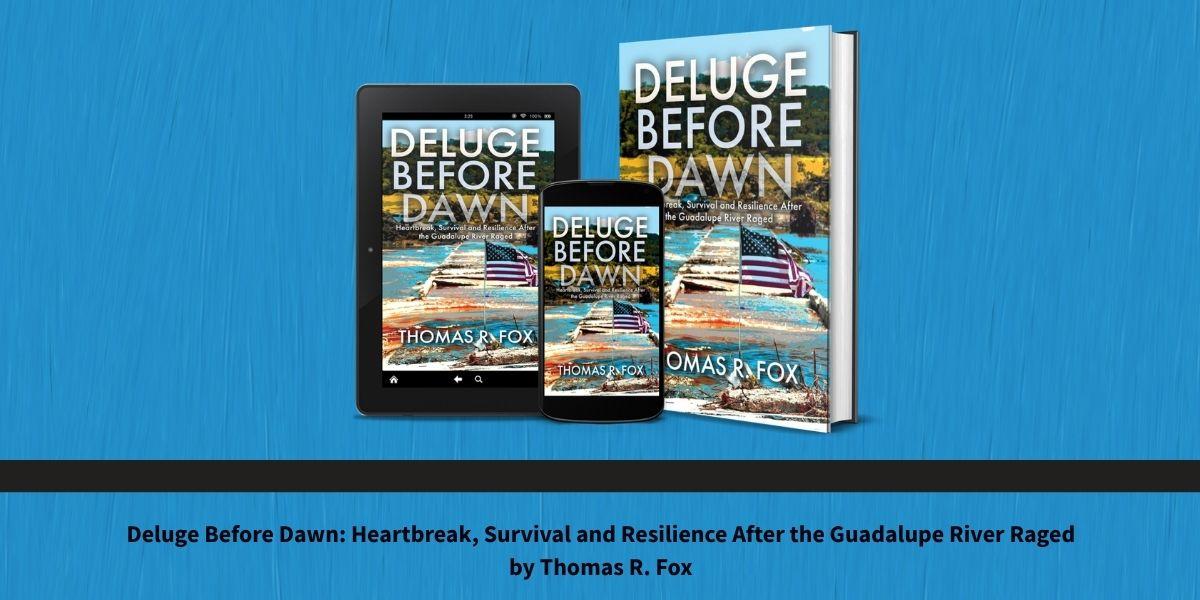
When a community is struck by catastrophe, the size and suddenness of the July 4, 2025 Guadalupe River flood, one of the first things at risk is the specific truth of what actually happened. Memory distorts under grief. Individual accounts fragment and contradict. Institutional narratives take shape to serve institutional interests. The voices of the people who were most directly in the path of the disaster, the campers at Camp Mystic, the families along the river, the first responders who drove toward what everyone else was fleeing, can get lost in the larger narrative machinery that surrounds a disaster of this magnitude. Thomas R. Fox understood that risk from the moment the waters receded, and Deluge Before Dawn is his most important act of community service: the careful, thorough, and deeply human record that ensures those voices will not be lost.
Fox is a Kerrville resident, a lawyer with more than forty years of experience and a nationally recognized reputation as a thinker about accountability and the human dimensions of institutional crisis. He is also, crucially, someone who knew the river and the communities along it before the flood, and who understood what was being destroyed and what was being tested in those dark hours in a way that an outside journalist arriving after the fact could not have matched. That insider knowledge gives the book its particular intimacy and authority, because the people he interviewed were talking to someone who understood the geography, the culture, and the specific human context of what they were describing.
He drew on dozens of intimate interviews and careful on-the-ground reporting to reconstruct the catastrophe from the first raindrops through the overnight evacuations and into the long aftermath of searches and vigils and funerals and the beginning of rebuilding. The result is a book that moves between the hourly reconstruction of events and the deeply personal testimonies of those who lived through them with the skill of a writer who understands that both dimensions are necessary for the complete account. The timeline gives the reader a structural understanding of what happened, when, and in what sequence. The voices give the reader the irreducible human truth of what it felt like to be inside it.
Fox is clear-eyed about institutional failures throughout, bringing to the question of what could have been done differently the same analytical rigor that has made him a recognized voice on risk management and compliance in his professional work. He does not treat those questions as accusations but as the necessary foundation for genuine preparedness, for the conversations that communities need to have about early warning systems and emergency response and the specific decisions that shape outcomes when a river rises faster than anyone anticipated. That dimension gives the book practical value beyond tribute and remembrance, making it essential reading not just for those who lived through July 4, 2025 but for every community that lives downstream of a river that has never quite done this before.
Deluge Before Dawn stands as both a tribute to those who were lost and a lasting record for those who will inherit the beauty and burden of the Guadalupe River in the years to come. Tom Fox has done something genuinely important here, and the community he has written about, and the wider reading public that needs to understand what happened in Kerr County on the Fourth of July, is considerably richer for it.
If you believe that remembrance is itself a form of service and that the stories of those who survived and those who were lost deserve to be told with the fullness and the honesty they deserve, Deluge Before Dawn by Thomas R. Fox is the book that fulfills that obligation. Copies are available on Amazon today.